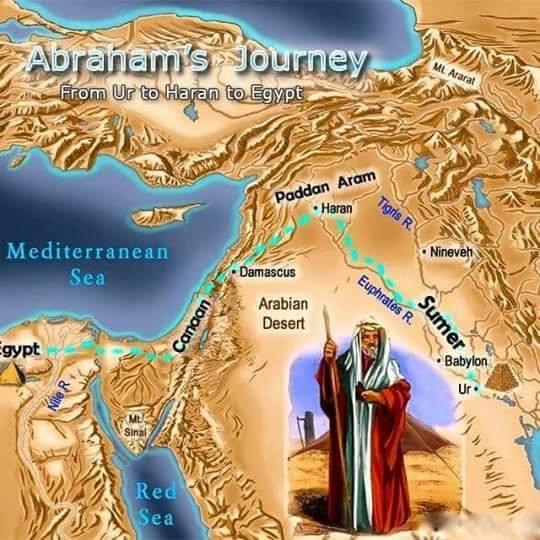
The life of Abraham is mapped differently in the Old Testament.
Here is what the Old Testament says about Abraham :
- God told Abraham, who was living in a pagan environment near the Euphrates, to leave his home and go to a land that God would show him (See Joshua 24:2)
2.Abraham’s family departed from “Ur of the Chaldeans to go to the land of Canaan,” where he lived in Shechem (modern day Nablus) around 1850 B.C. - Because of the famine that came upon Canaan (See Genesis 2:1-10), Abraham departed from Canaan and went to Egypt. From Egypt, he moved to Bethel, where he built a temple for the Lord (See Genesis 13:-4)
NOW reding about this in the Bible, we know that it mentions three regions in the narrative of Abraham’s journey. - The Euphrates. 2. Canaan. 3. Egypt.
At the same time, NO MENTION of the Arabian Peninsula (regarding Mecca) or a connection between Abrahaam and the Ka’ba is given. Do you not find this a bit odd ? I do.
So again, If Abraham had been the builder of the Ka’ba, it would have been a holy site for the Jews, or at least the historical tales would have mentioned their regard for it.
We also know this about the Ka’ba. According to classical Islamic sources, the name of this sacred house found found in Mecca DERIVE from its CUBICAL shape. In the Arabic, the word ka’ba means “cube”. The worship of Ka’ba is connected to Arab paganism because the Arabs of the Peninsula considered the Ka’ba holy BEFORE Islam.
The historic sources also also inform that the pagan Arabs regarded others houses named ka’ba (ka’bas) to be sacred as well, for example:
- Ka’ba of Yemen
- Ka’ba of Najran
- Ka’ba of Shadad
- Ka’ba of Ghatafan
Now, according to the historical sources, the number of ka’bat (ka’bas) may have been as many as 23. Regardless of the accuracy of this number, the consensus is that there are other ka’bat (ka’bas) besides the one in Mecca.
This raises ANOTHER intriguing question!
Since Abraham had NOT visited the southern Arabian Peninsula, and since the Ka’ba was at the heart of the Arabian Peninsula, HOW COULD ABRAHAM BE TIED TO THE Kaaba?