The Gospels describe the life and words of Jesus the Christ and the rest of the NT is centered around Jesus’ life, death and resurrection. But how do we know He even existed?
Well because scores of Roman, Jewish and Greek Historians that lived in the first centuries AD refer to Jesus and his movement on earth. We have all of these sources, some of which is directly compiled in this video:
https://www.youtube.com/watch?v=4bLlpiWh9-k&list=PLLuqiShajYW4IW9pDOgCCOnQ70C7tleNq&index=41&t=1385s
We also have manuscript copies of the original NT texts which are pretty much all dated within the same century Jesus lived in; the 1st century. Here’s a quick glance at the dates of some scolars: https://en.wikipedia.org/wiki/Dating_the_Bible
In fact the creed in 1 Corinthians 15:3-8 is even believed to be dated no more than 1 or 2 years after the resurrection of Jesus. Indicating the wide approval on this subject, even more skeptical scholars frequently agree.
Gerd Ludemann maintains that “the elements in the tradition are to be dated to the first two years after the crucifixion of Jesus. . . . not later than three years. . . . the formation of the appearance traditions mentioned in I Cor.15.3-8 falls into the time between 30 and 33 CE. . . .” [Gerd Ludemann, The Resurrection of Jesus, trans. John Bowden (Minneapolis: Fortress, 1994), 38 (Ludemann’s emphasis)]
Similarly, Michael Goulder thinks that it “goes back at least to what Paul was taught when he was converted, a couple of years after the crucifixion.” [Michael Goulder, “The Baseless Fabric of a Vision,” in Gavin D’Costa, editor, Resurrection Reconsidered (Oxford: Oneworld, 1996), 48.]
Thomas Sheehan agrees that this tradition “probably goes back to at least 32-34 C.E., that is, to within two to four years of the crucifixion.” [Thomas Sheehan, The First Coming: How the Kingdom of God became Christianity (New York: Random House, 1986), 118; cf. 110-111]
Others clearly consent. For instances, see A.J.M. Wedderburn, Beyond Resurrection (Peabody: Hendrickson, 1999), 274, note 265; Robert Funk, Roy W. Hoover, and the Jesus Seminar, The Five Gospels (New York: Macmillan, 1993), 24; Jack Kent, The Psychological Origins of the Resurrection Myth (London: Open Gate, 1999), 16-17; G.A. Wells, Did Jesus Exist? (London: Pemberton, 1986), 30
Which means that this creed…
1Co 15:3 For I delivered to you as of first importance what I also received: that Christ died for our sins in accordance with the Scriptures,
1Co 15:4 that he was buried, that he was raised on the third day in accordance with the Scriptures,
1Co 15:5 and that he appeared to Cephas, then to the twelve.
1Co 15:6 Then he appeared to more than five hundred brothers at one time, most of whom are still alive, though some have fallen asleep.
1Co 15:7 Then he appeared to James, then to all the apostles.
1Co 15:8 Last of all, as to one untimely born, he appeared also to me.
…about Jesus’ death, resurrection and post-mortem appearances was in existence not long after the time that Jesus’ died. So much for the possibility of “additions” about the core doctrines of the Christian faith.
So basically my point is that if one wants to know where Christianity came from and who Jesus was, the Gospels and the Paul’s letters are the most contemporary and reliable.
One might ask…’ how do we know that the texts are not tampered with’ but these sources are so early that there were still many living who had even witnessed Jesus. Every scripture could’ve been debunked by just going to grandpa to ask for the truth so to speak. This is also why the 1st century texts we have in the NT are authoritative above later manuscripts and doctrines from heretical sects like the Gnostics and whatnot.
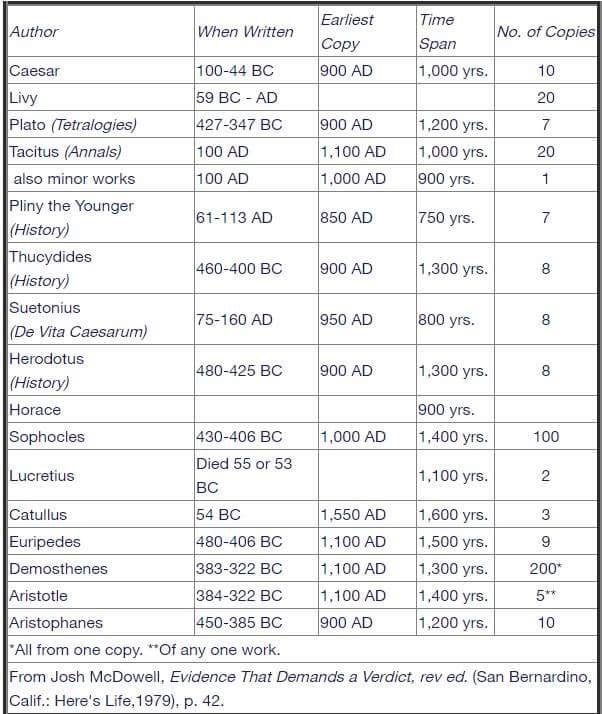
Biblical scripture is in another ballpark compared to other ancient sources yet it receives an an unreasonable amount of skepticism. See the table for contrast to other ancient sources which we trust fully.
A brief perusal of the table indicates that for a representative sample of ancient historical works, we possess only a handful of manuscripts which are, on the average, one thousand years removed from their originals.
In contrast to this, the New Testament documents have a staggering quantity of manuscript attestation. Approximately 5,000 Greek manuscripts, containing all or part of the New Testament, exist. There are 8,000 manuscript copies of the Vulgate (a Latin translation of the Bible done by Jerome from 382–405) and more than 350 copies of Syriac (Christian Aramaic) versions of the New Testament (these originated from 150–250; most of the copies are from the 400s). Besides this, virtually the entire New Testament could be reproduced from citations contained in the works of the early church fathers. There are some thirty-two thousand citations in the writings of the Fathers prior to the Council of Nicea (325).
https://www.bethinking.org/is-the-bible-reliable/the-historicity-of-the-new-testament
Of the four Gospels alone there are 19,368 citations by the church fathers from the late first century on. This includes 268 by Justin Martyr (100-165), 1038 by Irenaeus (active in the late second century), 1017 by Clement of Alexandria (ca. 155-ca. 220), 9231 by Origen (ca. 185-ca. 254), 3822 by Tertullian (ca. 160s-ca. 220), (ca. 160s-ca. 220), 734 by Hippolytus (d. ca. 236), and 3258 by Eusebius (ca. 265-ca.339; Geisler, 431).
Earlier, Clement of Rome cited Matthew, John, and 1 Corinthians, in 95 to 97. Ignatius referred to six Pauline epistles in about 110, and between 110 and 150 Polycarp quoted from all four gospels, Acts, and most of Paul’s epistles. Shepherd of Hermas (115-140) cited Matthew, Mark, Acts, 1 Corinthians, and other books. Didache (120-150) referred to Matthew, Luke, 1 Corinthians, and other books. Papias, companion of Polycarp, who was a disciple of the apostle John, quoted John. This argues powerfully that the gospels were in existence before the end of the first century, while some eyewitnesses (including John) were still alive.
https://www.bethinking.org/bible/the-dating-of-the-new-testament
What is also interesting is how the NT stands in regards to the empirical science of Archeology. So I would strongly recommend going through the following piece that deals with this on the categories of: Culture(Beliefs and Practices), Places (Urban centers and individual buildings) and People (Titles, Names and Relationships):
https://www.bethinking.org/is-the-bible-reliable/archaeology-and-the-historical-reliability-of-the-new-testament
But anyway YES the NT is hands down the most well attested and reliable collection of books of Antiquity.