| Topic | Christianity | Islam | Judaism |
| Origin of the Name | From the Greek:christos, ‘Anointed’ – referring to Jesus Christ. | Derived from an Arabic word for ‘submission’. Also related to the Arabic word salaam, ‘peace’. | From the Hebrew:Yehudim, ‘Judah’. |
| Founder | Jesus Christ (c. 4 B.C. – 30 A.D.) | Mohammed (570 – 632 A.D.) | Abraham (First Patriarch, born c. 1800 B.C.) |
| Divisions | Three main groups: Orthodox, Protestant and Roman Catholic. | Two main groups: Sunni and Shia (The division occured due to a dispute as to the legitimate successor of the prophet Mohammed). There is also a mystical/ascetic movement in Islam known as Sufi. | Several divisions, including Hasidic, Conservative and Reform Judaism. Ethnic groupings include Ashkenazi (The majority) and Sephardi Jews. |
| Followers (2020 Estimates) | (2.3 Billion) | (1.9 Billion) | 14 Million |
| Nature of God | One God, who exists in three distinct persons (The Trinity): Father, Son and Holy Spirit (Matthew 28:19). | One God (Arabic: Allah), who is not a trinity. The Islamic view of God is called strict Monotheism (Quran 112:1). | One God (known in English as ‘Yahweh’ or ‘Jehovah’) – “…Hear Israel, the Lord is our God, the Lord is one.” (Deuteronomy 6:4). |
| Holy Book(s) | The Bible (from the Greek:Biblos, ‘books’), given by God to man. The Bible writers were inspired by God in their writings. Thus Christians refer to the Bible as the Word of God (2 Timothy 3:16). | The Quran or Koran (Arabic: ‘recitation’), revealed to the prophet Mohammed over a period of about 20 years. The Quran is the final revelation given by Allah to mankind. | The Hebrew Tanakh, similar to the Christian Old Testament, comprised of the Torah (Hebrew: ‘Law’), Nevi’im (‘Prophets’) and Ketuvim (‘Writings’). |
| Jesus Christ | The second person of the Trinity and born of the Virgin Mary. “…true God from true God” | Isa (Jesus) was a prophet, sent by Allah and born of the Virgin Mary, but not divine (Quran 5:17). | An ordinary Jew, not the Messiah nor a divine person. |
| Jesus Christ, The Mission of | To reconcile Man to God, through his death as a sacrifice for the sins of all mankind. | To proclaim the Injil, or gospel. This gospel has been corrupted over time by human additions and alterations. | As Judaism rejects the idea of Jesus as Messiah, his mission is of no relevance. |
| Jesus Christ, The Death of | “…For our sake he was crucified…he suffered death and was buried. On the third day he rose again…he ascended into heaven…” | Jesus was not crucified (Quran 4:157), but was raised to Heaven by Allah (4:158). | Jesus was crucified for his claim to be divine. |
| Holy Spirit | The third person of the Trinity, truly divine: “….with the Father and the Son he is worshipped and glorified.” | Identical with the Angel Gabriel, who appeared to the Prophet Mohammed giving him the Quranic text. | Not a distinct person, but a divine power which for example, was given to the Prophets. |
| Other Traditions | The writings of the early church fathers and ecumenical councils, including the Creeds. | The Hadith, a collection of traditions/sayings of the Prophet Mohammed. The Hadith functions as a supplement to the Quran, giving guidance to Muslims for daily living. | The Talmud, an oral tradition explaining and interpreting the Tanakh. It includes the Mishnah – a code of Jewish law. |
| Examples of Rituals | The Sacraments, including Baptism and Holy Communion(Eucharist). In Orthodoxy and Roman Catholicism, five more are added, viz: Confirmation (Chrismation), Marriage, Penance, Holy Orders and Anointing of the sick. Prayer is also an important part of the faith. | Five important rituals (known as the pillars of Islam): 1. Shahadah – A profession of faith. 2. Salat – Prayer five times daily. 3. Zakat – alms giving. 4. Sawm – Fasting during the Holy month of Ramadan. 5. Hajj – Pilgrimage to the Holy city of Mecca. | Rituals include the Circumcision of newly born Jewish males, Barmitzvah – a ceremony marking the ‘coming of age’ of Jewish Boys and observation of the Sabbath (Shabat). As in the other faiths, prayer is important. The Jewish prayer book is called the siddur. |
| Sin | We inherit a sinful nature through our common ancestor Adam, who rebelled against God. Jesus Christ atoned for our sins through his death on the Cross (Romans 5:12-17). | There is no concept of original sin, nor vicarious atonement. All Humans are born sinless, but human weakness leads to sin. | Judaism rejects the doctrine of original sin. Atonement for sins commited is made through seeking forgiveness from God in prayer and repentance. In addition, the day of atonement (Yom Kippur) is set aside specially for this purpose. |
| Salvation | By grace through faith in Jesus Christ (Ephesians 2:8-9).3 | Achieved through good works, thus personal righteousness must outweigh personal sin (Quran 23:101-103). | Through good works, prayers and the grace of God. There is no parallel to the Christian view of substitutionary atonement. |
| Hell | A place of everlasting punishment for the unrighteous (Matthew 25:46). There is no crossover between Heaven and Hell. | A place of torment and fire (Quran 25:65, 104:6-7). In Islam, Hell is known as Jahannam. Jahannam has several levels and a person may not necessarily spend eternity there. | Tradtionally, there is the concept of Gehinnom or Gehenna – those who die in sin may suffer temporary punishment, but certain sins merit eternal punishment. However, Judaism’s ideas of the afterlife have varied widely among different groups and in different time periods. For the most part, Judaism does not emphasize the afterlife. |
| Topic | Christianity | Islam | Judaism |
All posts by David Stevenson
Protevangelium
The first mention in the Old Testament that the coming Christ would be born of a virgin occurs right at the beginning.
And I will put enmity between thee and the woman, and between thy seed and her seed: it shall bruise thy head, and thou shalt bruise his heel.
Genesis 3:15
This prophecy, known as the Protevangelium, comes from the most ancient oracle known to man, the oracle that the Lord pronounced when He found our first parents, Adam and Eve, guilty of sin. The Lord is speaking to Satan, who has enticed “the woman,” Eve, into disobeying the Lord’s command against eating fruit from the Tree of the Knowledge of Good and Evil. He is saying that Satan will someday be crushed and utterly defeated by the seed of the woman.
The pronoun used to designate the seed is “his” (in “his heel”). In place of “it” (in “it shall bruise”), the more accurate translation is “he” (1). Therefore, the coming conqueror must be a single man. But why is He called the seed of a woman? A child is ordinarily regarded as the seed of his father and forefathers. The striking and unnatural character of the expression “her seed” suggests that it is a uniquely fitting name for the victor over Satan. Unlike other men, He would be the seed of a woman only. He would not be a man’s seed. A virgin would conceive Him without losing her virginity.
Isaiah’s Oracle
Over seven hundred years before Jesus was born, the prophet Isaiah enlarged upon the Protevangelium.
Therefore the Lord himself shall give you a sign: Behold, a virgin shall conceive, and bear a son, and shall call his name Immanuel.
Isaiah 7:14
The name Immanuel means, “God with us.” Isaiah is appending to Genesis 3:15 the information that the virgin-born conqueror of Satan would be God Himself in the flesh.
Matthew 1.20
Matthew 1:21–23 She will bear a son, and you shall call his name Jesus, for he will save his people from their sins.” 22 All this took place to fulfill what the Lord had spoken by the prophet:
23 “Behold, the virgin shall conceive and bear a son, and they shall call his name Immanuel”
https://www.desiringgod.org/messages/the-fall-of-satan-and-the-victory-of-christ
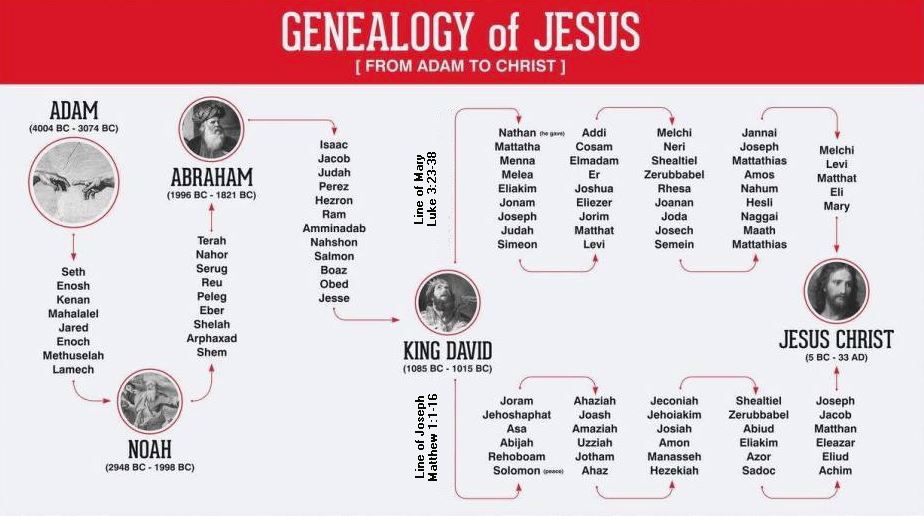
Jesus Genealogy
Why Jesus Never Said I am God!
Introduction
Christians often hear Muslims say, “Jesus never said the words “I am God” anywhere in the four gospels.” In one sense this is a true observation. There is nowhere in the four gospels where the Lord Jesus Christ ever uttered the statement, “I am God.” So, our Muslim missionary friends rest their case assuming that they have discovered an irrefutable argument that the Lord Jesus Christ never claimed to be God. And often, they suggest that this claim was a Pauline addition to Christian doctrine.
However, little do they know, their observation is really further evidence for the truth of the doctrine of the Tri-unity of God and Deity of Christ.
Let’s assume for the moment that the Lord Jesus Christ had said, “I am God.” What would the significance of this claim have meant to His Jewish hearers? It would have meant one of the following erroneous claims:
He was identical to the God of the Old Testament - Identity.

He was an additional God to the God of the Old Testament - Polythesism.

He was one of the different manifestations of the single personhood of God - Sabellianism.
Identity
To some of His hearers, the statement, “I am God,” would have meant that the Lord Jesus Christ was claiming to be identical to God and that He was only a man in outward appearance or semblance. In fact, this was one of the heresies that arose during the days of the Apostles of Christ in which Christ’s true humanity was not acknowledged. In the first and second epistles of the Apostle John, there is a condemnation directed toward those who claimed that Jesus Christ was not come in real human flesh (1 John 4:3).
For many deceivers have gone out into the world, those who do not confess the coming of Jesus Christ in the flesh. Such a one is the deceiver and the antichrist. 2 John 1:7It is true there were various instances in the Old Testament when a theophany of God appeared in human form. These theophanies were instances of a divine appearance in a human form. For example, the father of Samson, Manoah, saw a theophany of the LORD before the birth of Samson.
 18 And the angel of the Lord said to him, “Why do you ask my name, seeing it is wonderful?” 19 So Manoah took the young goat with the grain offering, and offered it on the rock to the Lord, to the one who works[a] wonders, and Manoah and his wife were watching. 20 And when the flame went up toward heaven from the altar, the angel of the Lord went up in the flame of the altar. Now Manoah and his wife were watching, and they fell on their faces to the ground.

21 The angel of the Lord appeared no more to Manoah and to his wife. Then Manoah knew that he was the angel of the Lord. 22 And Manoah said to his wife, “We shall surely die, for we have seen God.”
Judges 13:18-22
However, Jesus was not a theophany of God who only appeared to be a human being. So, if the Lord Jesus Christ had said, “I am God,” many would have taken it to mean that Christ was denying His humanity and that He was claiming to be God of the Old Testament in a theophanic manifestation.
However, the life—birth, life, death, and resurrection—of the Lord Jesus Christ was not a theophany of God. The Savior possessed a real human nature from the blessed virgin Mary. Hence, if Christ had said, “I am God,” as our Muslims friends demand, it would have been a denial of His real humanity. And, without the real humanity of the Lord Jesus Christ, He could not have been the Savior of Sinners. Because, the penalty of sin is death, and the Lord Jesus Christ could not have really died upon the Cross of Calvary, as our Substitute, if He had not possessed a true human nature. So, no wonder the Apostle John called a person who denied the real humanity of our Savior, a “deceiver and the antichrist.”
Polytheism
To other of His Jewish listeners, it would have meant polytheism or Greek paganism. The Jews knew the scriptures of the Old Testament prophets where they studied the one true God under various names, such as: Adonai, El, Elohim, or Yaweh. The Israelites understood too that these terms referred to a single Supreme Being who is the Creator, Sustainer, Governor, and ultimate Judge of the universe. So, if the Lord Jesus Christ had stated, “I am God,” these other Jews may have thought that Jesus was claiming to be another God alongside the God of the Old Testament scriptures. Of course, the Lord Jesus Christ never claimed to be another God in addition to the God of the Old Testament scriptures. He taught there is only one Being, God, who exists in three persons: Father, Son, and Holy Spirit.
Sabellianism
To some individuals, it would have meant the identification of His person with the total personhood of God (Sabellianism). Sabellianism is the idea there is one personal Deity who may be understood in different ways. For example, in human terms, one person may be understood in different personal ways too, One person may be simultaneously a father, a son, a brother, a husband, an uncle, or a grandfather. These various terms do not mean that one person is many persons. The heresy of Sabellius was the idea that the Father, the Son, and the Holy Spirit were terms that referred to one divine person who may be considered in these three different modes. But, the Holy Scripture teaches us that the Father, the Son, and the Holy Spirit are distinctly different persons within the one God.
So, if the Lord Jesus had said, “I am God,” this may have been interpreted to mean that Jesus was claiming He was identical to the total personhood of God. But, the Lord Jesus Christ never claimed to be the totality of the personhood of God. If it were true that the Lord Jesus Christ had said, “I am God,” it would have be evidence against the doctrine of the Trinity. The Lord Jesus Christ is not the entire personhood of God, as the statement, “I am God,” would entail. The person of the Lord Jesus Christ is the Son and not the person of the Father nor the Holy Spirit.
Conclusion
Instead of making the claim, “I am God,” the Lord Jesus Christ properly described Himself in terms of the divine Son in a manner that no created being could share. Throughout the gospels He asserted over and over that He is the divine Son of God. When the New Testament scriptures are seriously examined, we discovered that Christ taught that the one God exists eternally in three divine persons: the Father, the Son, and the Holy Spirit. In His person, He claimed a distinction from the personhood of the Father and the Holy Spirit in various ways.
I and my Father are one. John 10:30
 Jesus answered, “The most important is, ‘Hear, O Israel: The Lord our God, the Lord is one. Mark 12:29
Son and Father:
1 For as the Father raises the dead and gives them life, so also the Son gives life to whom he will. 22 For the Father judges no one, but has given all judgment to the Son, 23 that all may honor the Son, just as they honor the Father. Whoever does not honor the Son does not honor the Father who sent him. 24 Truly, truly, I say to you, whoever hears my word and believes him who sent me has eternal life. He does not come into judgment, but has passed from death to life.
John 5:21-24
Son and Holy Spirit:
2 “But when the Helper comes, whom I will send to you from the Father, the Spirit of truth, who proceeds from the Father, he will bear witness about me. John 15:26Furthermore, the Lord Jesus Christ said that He is the divine Son who is the eternal begotten Word of the Father.
In the beginning was the Word, and the Word was with God, and the Word was God. 2 He was in the beginning with God. 3 All things were made through him, and without him was not any thing made that was made. 4 In him was life,[a] and the life was the light of men. John 1:1-4And the Word became flesh and dwelt among us, and we have seen his glory, glory as of the only Son[a] from the Father, full of grace and truth. John 1:14So, if Christ had preached, “I am God,” it would have been understood as a denial of the deity of the Father and the Holy Spirit. Secondly, and more importantly, it would have been a denial of His humanity. The Lord Jesus Christ had to possess a real human nature in order to die as a sacrifice for sinners upon the Cross.
Two Christian scholars note that the Lord Jesus Christ presented Himself as the divine Son of God.
This is not the same thing as saying that each of the three divine Hypostases apart and by Himself is God. On the contrary, the Son and the Holy Spirit are God only by virtue of the eternal divine Oneness, in which the Father, the Son and the Holy Spirit are one and only one God. Therefore the Lord Jesus Christ never and nowhere said that He, apart from the Father, was God; nay, rather, always and everywhere He taught His own Deity as resulting from His oneness with the Father. — C. G. Pfander in Miftah-ul-Asrar 1§ 3. That Christ claimed to be fully divine is hardly open to serious dispute by those who accept the Gospels as containing a substantially true account of apostolic experience of Him. It is true that He never made the unqualified assertion, "I am God, " which by Jewish minds would have been taken to mean either an identification of His Person with that of the Father (Sabellianism) or the proclamation of a second God (Polytheism). He described Himself in terms of divine sonship—that was sharply distinguished from any in which His listeners could participate, and one that involved internal relations to the Father which cannot be enjoyed by created persons. — F. J. Hall in Dogmatic Theology: Vol. VI, The Incarnation 2