All posts by David Stevenson

Abraham and the Kaaba

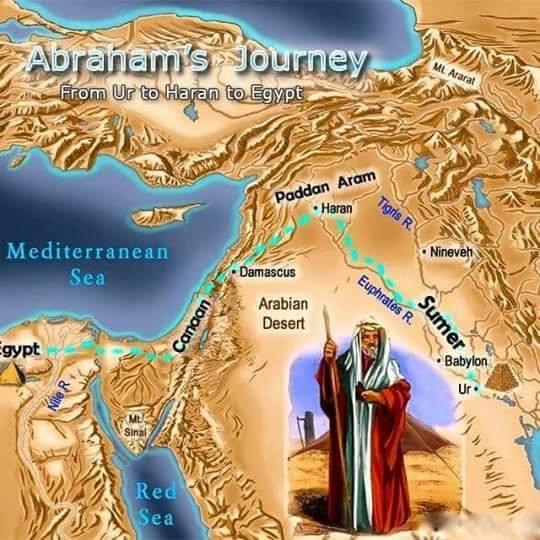
The life of Abraham is mapped differently in the Old Testament.
Here is what the Old Testament says about Abraham :

  1. God told Abraham, who was living in a pagan environment near the Euphrates, to leave his home and go to a land that God would show him (See Joshua 24:2)
    2.Abraham’s family departed from “Ur of the Chaldeans to go to the land of Canaan,” where he lived in Shechem (modern day Nablus) around 1850 B.C.
  2. Because of the famine that came upon Canaan (See Genesis 2:1-10), Abraham departed from Canaan and went to Egypt. From Egypt, he moved to Bethel, where he built a temple for the Lord (See Genesis 13:-4)
    NOW reding about this in the Bible, we know that it mentions three regions in the narrative of Abraham’s journey.
  3. The Euphrates. 2. Canaan. 3. Egypt.
    At the same time, NO MENTION of the Arabian Peninsula (regarding Mecca) or a connection between Abrahaam and the Ka’ba is given. Do you not find this a bit odd ? I do.
    So again, If Abraham had been the builder of the Ka’ba, it would have been a holy site for the Jews, or at least the historical tales would have mentioned their regard for it.
    We also know this about the Ka’ba. According to classical Islamic sources, the name of this sacred house found found in Mecca DERIVE from its CUBICAL shape. In the Arabic, the word ka’ba means “cube”. The worship of Ka’ba is connected to Arab paganism because the Arabs of the Peninsula considered the Ka’ba holy BEFORE Islam.
    The historic sources also also inform that the pagan Arabs regarded others houses named ka’ba (ka’bas) to be sacred as well, for example:
  • Ka’ba of Yemen
  • Ka’ba of Najran
  • Ka’ba of Shadad
  • Ka’ba of Ghatafan
    Now, according to the historical sources, the number of ka’bat (ka’bas) may have been as many as 23. Regardless of the accuracy of this number, the consensus is that there are other ka’bat (ka’bas) besides the one in Mecca.
    This raises ANOTHER intriguing question!
    Since Abraham had NOT visited the southern Arabian Peninsula, and since the Ka’ba was at the heart of the Arabian Peninsula, HOW COULD ABRAHAM BE TIED TO THE Kaaba?

Baca

So the people who were going to Zion in Psalm 84 did an impossible 1200 mile detour past Mecca.

You clearly don’t understand that this means the valley of weeping.

The Hebrew word baca is related to bakah, which means “to weep.” Baca refers to a type of “weeping” tree; that is, one that drips resin or gum-like tears, such as a balsam, mulberry, or aspen tree. In 2 Samuel 5:23, bakaim is translated as “balsam trees”

The Valley of Baca was probably a literal place located near Jerusalem. The Valley of Rephaim (2 Samuel 5:18) is a possible identification. The Valley of Rephaim is the site of one of David’s victories over the Philistines; the author of 2 Samuel notes that there were balsam trees there (verse 23). Another possibility is that the Valley of Baca is the Valley of Achor (Joshua 7:24), the place of Israel’s trouble where Achan was executed for bringing guilt upon the nation. In the psalmist’s day, pilgrims probably passed through this water-less valley on their way to Jerusalem to worship.

Let us to evaluate the claim that it is Mecca:

v.1 – ‘How lovely is your dwelling place, O Lord Almighty!’
v.3 – ‘… a place near your altar, O Lord Almighty …’
v.4 – ‘Blessed are they who dwell in your house’
v.7 – ‘They go from strength to strength, till each appears before God in Zion.’
v.10 – ‘I would rather be a doorkeeper in the house of my God …’

Does the Kaaba in Mecca have an alter?
Do people live in the Kaaba?

Why would the pilgrims in Psalm 84 make a massive detour to Mecca, as their destination is given as Zion. Mount Zion is one of the hills on which Jerusalem is founded. In the Bible Zion is often used synonymously with Jerusalem (Isaiah 2:2)

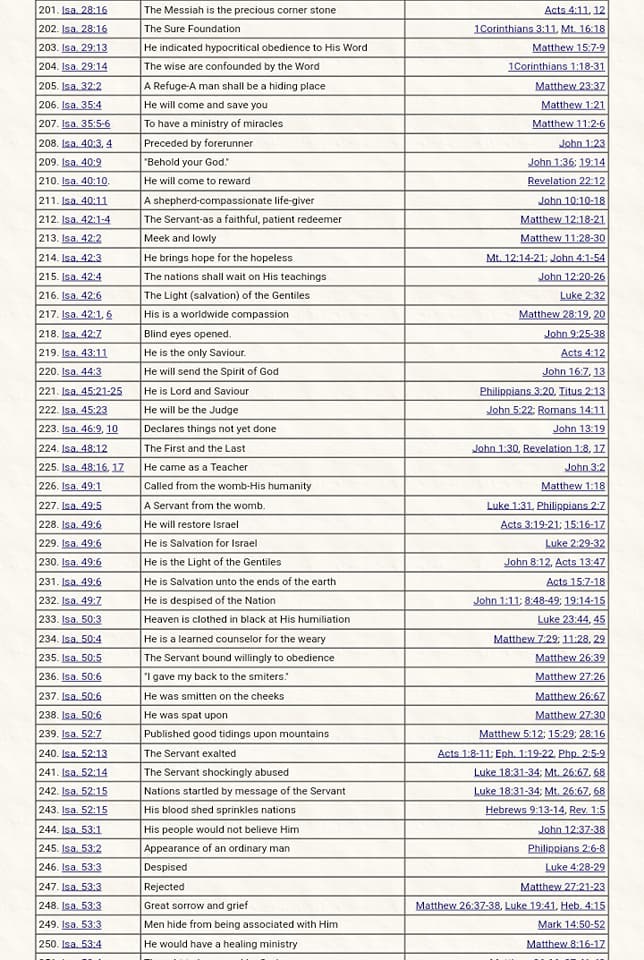
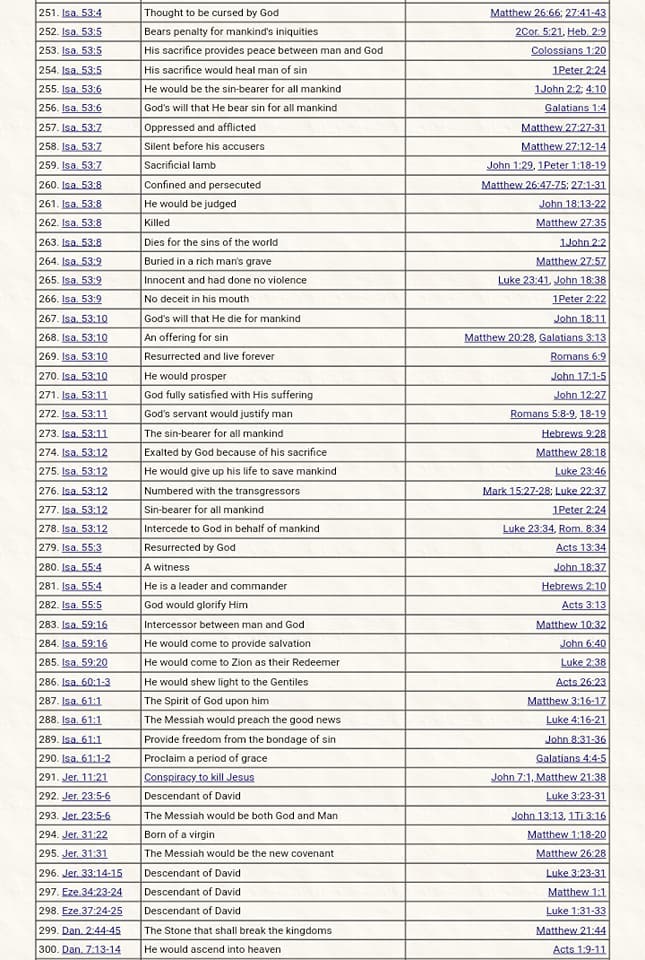
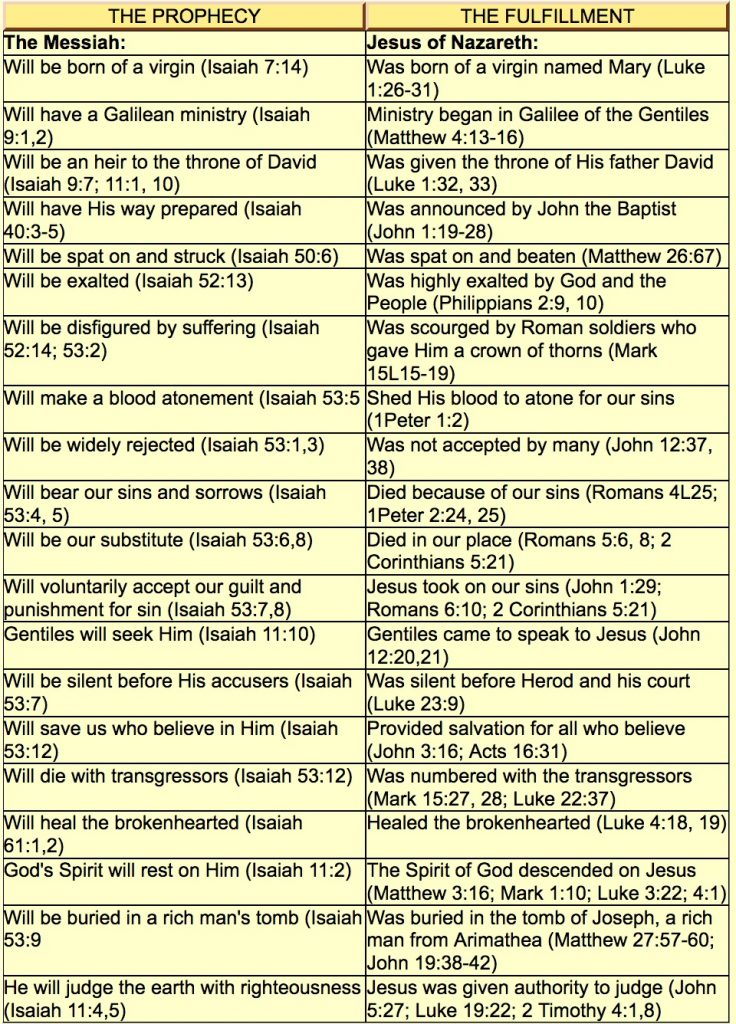
The Messiah Would be God!

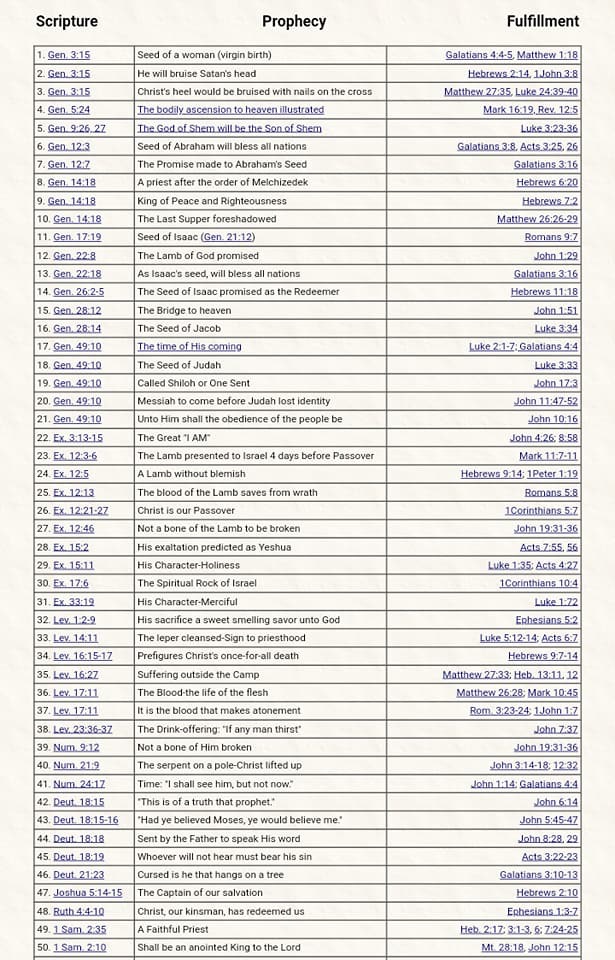
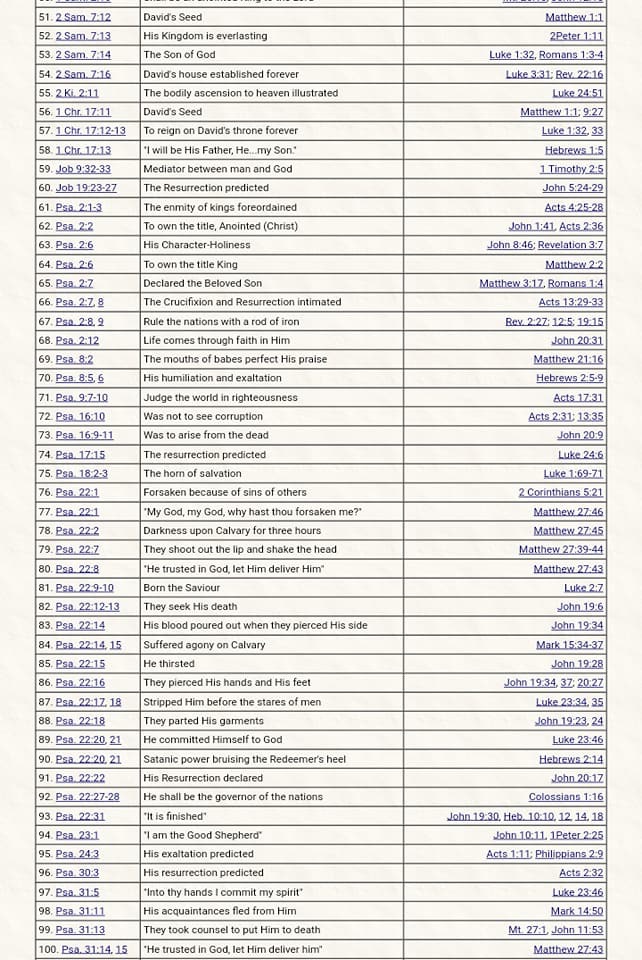
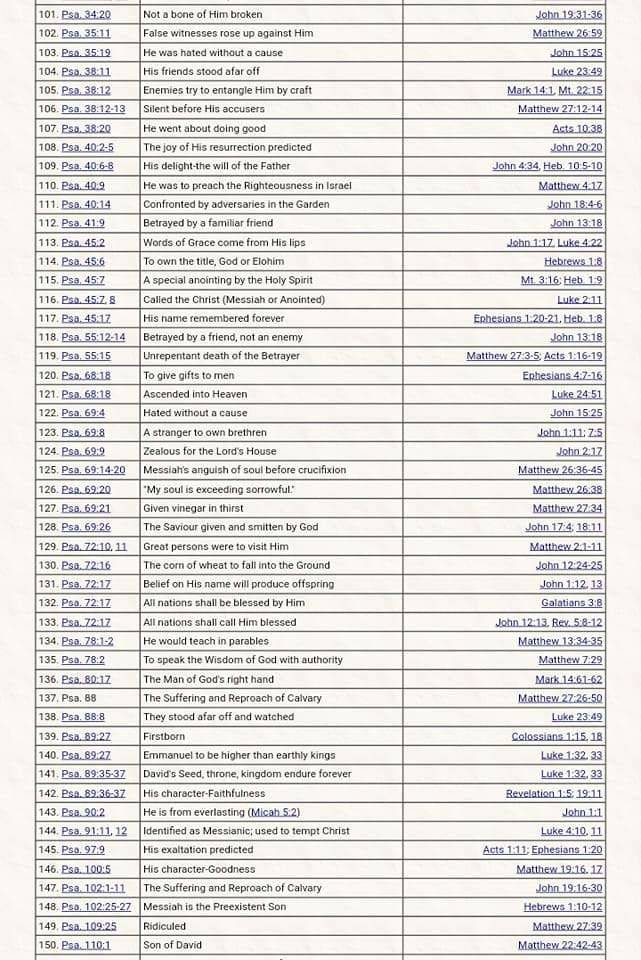
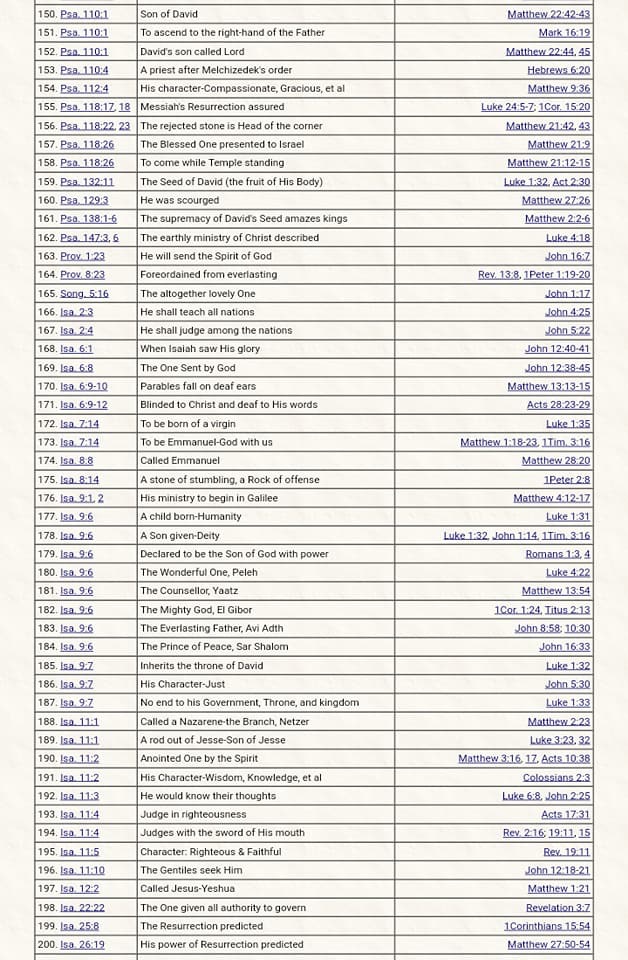
Prophecy: Isaiah 9:6–7
Fulfillment: Matthew 12:42; Luke 1:32–33, 79; John 14:27; Acts 10:36; Romans 9:5; Philippians 4:17; Colossians 2:3; 2 Thessalonians 3:3

In the midst of a messianic section extending from Isaiah 7 to Isaiah 12, we find an extraordinary pair of verses:

For to us a child is born, to us a son is given; and the government shall be upon his shoulder, and his name shall be called Wonderful Counselor, Mighty God, Everlasting Father, Prince of Peace.

Of the increase of his government and of peace there will be no end, on the throne of David and over his kingdom, to establish it and to uphold it with justice and with righteousness from this time forth and forevermore. The zeal of the Lord of hosts will do this. (Isaiah 9:6-7; Hebrew Bible, verses 5-6).

In these verses, a child is at the forefront of Isaiah’s prophecies, as it was in Isaiah 7:14. This time the child is given a name consisting of four exalted titles.

Is that child God?

This name has generated much discussion. Is it a description of the child himself? Then we would translate it as something like, “Wonderful Counselor, Mighty God, Everlasting Father, the Prince of Peace.” This means that the child himself is called Counselor, God, Father, and Prince.

Or, like many biblical names, is it a statement about God? Then we would translate it as something like, “Wonderful in Counsel is the Mighty God, the Everlasting Father, the Prince of Peace,” making the name into a sentence about God.

The Jewish Publication Society version of 1985, along with various other versions, translates the name as a statement about God. Interestingly, though, some Jewish traditions applied the names directly to the child. For example, Deuteronomy Rabbah says that “The Messiah is called by eight names,” and includes five references to the Isaiah verses, saying that among the Messiah’s names are Wonderful, Counselor, God, Hero, and Eternal Father of Peace (The Hebrew for each name, as found in Isaiah, is pele’, yo’etz, el, gibbor, avi’ ad shalom). The Midrash Pereq Shalom says that the Messiah’s name is Peace, quoting from these verses, “for it is said, Everlasting Father, Prince Peace.”1 The Targum to Isaiah—a translation into Aramaic—as well as the medieval commentator Ibn Ezra also refer the names to the child.2

The future king

It helps to look at the context of Isaiah 7–12, in which the prophet sees a future time of unparalleled prosperity, wisdom, and peace. We know that no period such as Isaiah describes was ever realized under any king of Israel or Judah. This is why as we move through the prophets and into the later books of the Old Testament, we find that there is still the hope for a future ruler and a future period of blessing and prosperity. By the end of the Old Testament, that ruler has still not arrived. This means that Isaiah 9 and similar passages awaited their fulfillment beyond the Old Testament, even if some human kings did display wisdom or brought a measure of peace.

And beyond the Old Testament is exactly where we find Isaiah 9:6-7 fulfilled:

Luke 1:32-33 describes Jesus as ruler on the throne of David, exactly as Isaiah 9:7 (Hebrew Bible, v. 6) describes in the verse that follows immediately after 9:6-7. There Isaiah says about the child, “Of the increase of his government and of peace there will be no end, on the throne of David and over his kingdom.” Luke, in similar words, says:

“He will be great and will be called the Son of the Most High. And the Lord God will give to him the throne of his father David, and he will reign over the house of Jacob forever, and of his kingdom there will be no end.” (Luke 1:32-33)

The Prince of Peace

Luke 1:79 similarly tells about Jesus bringing peace, just as the child of Isaiah 9 is called the “Prince of Peace”: Jesus will “give light to those who sit in darkness and in the shadow of death, [and will] guide our feet into the way of peace.” Jesus himself said in John 14:27, “Peace I leave with you; my peace I give to you. Not as the world gives do I give to you. Let not your hearts be troubled, neither let them be afraid.” And Peter, in Acts 10:36, speaks about God and says, “As for the word that he sent to Israel, preaching good news of peace through Jesus Christ…”

The New Testament throughout shows that Jesus is indeed the “Mighty God” who has come among us as a human being. Jesus does things only God can do, such as forgive sins and command nature to obey him. The writers of the New Testament apply directly to Jesus verses from the Old Testament that referred to God. And verses such as Romans 9:5 are explicit: “To them [the Jewish people] belong the patriarchs, and from their race, according to the flesh, is the Messiah, who is God over all, blessed forever. Amen.”

As to being wise in counsel (or, a Wonderful Counselor) Jesus spoke of himself in this way: “The queen of the South will rise up at the judgment with this generation and condemn it, for she came from the ends of the earth to hear the wisdom of Solomon, and behold, something greater than Solomon is here” (Matthew 12:42). Colossians 2:3 tells us that in Jesus “are hidden all the treasures of wisdom and knowledge.” And as for being the “Everlasting Father” (in Isaiah, a title that meant “protector”), Philippians 4:17 says that “the peace of God, which surpasses all understanding, will guard your hearts and your minds in Messiah Jesus”—combining peace and protection together. And in 2 Thessalonians 3:3, we read that, “the Lord is faithful. He will establish you and guard you against the evil one.”

Was Isaiah speaking of a human king of his time, as some believe? The kings of Israel never brought about the everlasting rule and time of justice and righteousness that Isaiah described. Some individual kings brought in temporary peace, some displayed wisdom, some displayed godly attributes. Many did not. But only the Messiah will do so permanently. Jesus the Messiah has begun that process, and will bring it to fruition.

Jesus and Paul

Some critics of Christianity try and set Paul against Jesus. They will often claim that what Paul taught is not what Jesus said and that present-day Christianity is derived not from Jesus, but from Paul’s teaching. This is an erroneous claim that does not fit the facts. It is easy to take various scriptures out of context and try and set one person against another — as many critics of Christianity have done. Nevertheless, we can confidently expect that Jesus and Paul taught the same thing. Granted, Paul focused more on theological issues than Jesus did, but nothing Paul said is contrary to Christ.

Luke wrote both the Gospel of Luke and the book of Acts. In Acts 9 Luke records the events surrounding Paul’s conversion. We see that Jesus himself called Paul and sent him to be an apostle. If Paul and Jesus are not in agreement, then why would Jesus call Paul to be his apostle? Jesus is God in flesh and would therefore know all things. Jesus would certainly have known what Paul would teach which, it seems, is one of the reasons Jesus called him.

In addition, we can quickly see by examining what Jesus said we find parallels in what Paul said. Following is a brief alphabetical list comparing the words of Christ with the words of Paul. We can clearly see that they were indeed in agreement and that the critics who would set Paul against Christ don’t know what they’re talking about.

Alive in Christ
Jesus
“For just as the Father raises the dead and gives them life, even so the Son also gives life to whom He wishes,” (John 5:21).

Paul
For as in Adam all die, so also in Christ all shall be made alive,” (1 Cor. 15:22).

Anxiety
Jesus
“For this reason I say to you, do not be anxious for your life, as to what you shall eat, or what you shall drink; nor for your body, as to what you shall put on. Is not life more than food, and the body than clothing?” (Matt. 6:25).

Paul
“Be anxious for nothing, but in everything by prayer and supplication with thanksgiving let your requests be made known to God,” (Phil. 4:6).

Atonement
Jesus
“I am the good shepherd; the good shepherd lays down His life for the sheep,” (John 10:11)

Paul
“and walk in love, just as Christ also loved you, and gave Himself up for us, an offering and a sacrifice to God as a fragrant aroma,” (Eph. 5:2).

Deity of Jesus
Jesus
“Truly, truly, I say to you, before Abraham was born, I am,” (John 8:58). Compare with Exodus 3:14, “And God said to Moses, “I AM WHO I AM”; and He said, “Thus you shall say to the sons of Israel, “I AM has sent me to you.”

Paul
“For in Him all the fullness of Deity dwells in bodily form,” (Col. 2:9). See also, Phil. 2:5-8.

Forgiveness
Jesus
“For if you forgive men for their transgressions, your heavenly Father will also forgive you,” (Matt. 6:14).

Paul
“And be kind to one another, tender-hearted, forgiving each other, just as God in Christ also has forgiven you,” (Eph. 4:32).

Jesus is the only way
Jesus
“Jesus said to him, “I am the Way, and the Truth, and the Life; no one comes to the Father, but through Me,” (John 14:6).

Paul
“For there is one God, and one mediator also between God and men, the man Christ Jesus,” (1 Tim. 2:5).

Justification by faith
Jesus

“Truly, truly, I say to you, he who hears My word, and believes Him who sent Me, has eternal life, and does not come into judgment, but has passed out of death into life,” (John 5:24). See also John 3:16-18; Luke 18:9-13.

Paul
“Therefore having been justified by faith, we have peace with God through our Lord Jesus Christ,” (Rom. 5:1).

Law, the
Jesus
“Do not think that I came to abolish the Law or the Prophets; I did not come to abolish, but to fulfill,” (Matt. 5:17).

Paul
“Do we then nullify the Law through faith? May it never be! On the contrary, we establish the Law,” (Rom. 3:31).
“What I am saying is this: the Law, which came four hundred and thirty years later, does not invalidate a covenant previously ratified by God, so as to nullify the promise,” (Gal. 3:17).

Law, living the
Jesus
“You shall not commit murder; You shall not commit adultery; You shall not steal; You shall not bear false witness; 19 Honor your father and mother; and You shall love your neighbor as yourself,” (Matt. 19:18-19).

Paul
“Owe nothing to anyone except to love one another; for he who loves his neighbor has fulfilled the law. 9 For this, “You shall not commit adultery, You shall not murder, You shall not steal, You shall not covet,” and if there is any other commandment, it is summed up in this saying, “You shall love your neighbor as yourself.” 10 Love does no wrong to a neighbor; love therefore is the fulfillment of the law,” (Rom. 13:8-10)

Predestination
Jesus
“Not all men can accept this statement, but only those to whom it has been given,” (Matt. 19:11).”All that the Father gives Me shall come to Me, and the one who comes to Me I will certainly not cast out,” (John 6:37).
“No one can come to Me, unless the Father who sent Me draws him; and I will raise him up on the last day,” (John 6:44).
“For this reason I have said to you, that no one can come to Me, unless it has been granted him from the Father,” (John 6:65).

Paul
“He predestined us to adoption as sons through Jesus Christ to Himself, according to the kind intention of His will… 11 also we have obtained an inheritance, having been predestined according to His purpose who works all things after the counsel of His will,” (Eph. 1:5,11).

Resurrection
Jesus
“The Son of Man is going to be delivered into the hands of men; 23 and they will kill Him, and He will be raised on the third day,” (Matt. 17:22-23).

Paul
“For I delivered to you as of first importance what I also received, that Christ died for our sins according to the Scriptures, 4 and that He was buried, and that He was raised on the third day according to the Scriptures,” (1 Cor. 15:3-4).

Rewards and Punishment
Jesus
“For the Son of Man is going to come in the glory of His Father with His angels; and will then recompense every man according to his deeds,” (Matt. 16:27).

Paul
“who will render to every man according to his deeds,” (Rom. 2:6).

Sinfulness of man
Jesus”For out of the heart come evil thoughts, murders, adulteries, fornications, thefts, false witness, slanders. 20 “These are the things which defile the man; but to eat with unwashed hands does not defile the man,” (Matt. 15:19-20).

Paul
“There is none who understands, There is none who seeks for God; 12 All have turned aside, together they have become useless; There is none who does good, There is not even one,” (Rom. 3:11-12).

Tradition
Jesus
“And why do you yourselves transgress the commandment of God for the sake of your tradition?” (Matt. 15:3).

Paul
“See to it that no one takes you captive through philosophy and empty deception, according to the tradition of men, according to the elementary principles of the world, rather than according to Christ,” (Col. 2:8).

Works Righteousness denied
Jesus
“Many will say to Me on that day, ‘Lord, Lord, did we not prophesy in Your name, and in Your name cast out demons, and in Your name perform many miracles?’ 23 “And then I will declare to them, “I never knew you; depart from Me, you who practice lawlessness,” (Matt. 7:22-23).

Paul
“Now that no one is justified by the Law before God is evident; for, “The righteous man shall live by faith,” (Gal. 3:11).

As you can see, this brief list demonstrates that Jesus and Paul both taught the same thing
The Other Sheep

John 10 Verse 16
And I have other sheep that are not of this fold. I must bring them also, and they will listen to my voice. So there will be one flock, one shepherd.

To understand who the “other sheep” from John 10:16 are, we must begin with the context of the verse and examine the whole passage. We know from many Bible passages that sheep are a symbol of true believers who follow Christ, their true Shepherd. His sheep hear His voice and follow Him. If He says that there are “other” sheep, then we must identify the original sheep that the “others” are different from.

Beginning in chapter 9 of John, we find Jesus discoursing at great length with the Pharisees after He healed a man who was born blind. He compares the man’s simple faith with the unbelief of the Pharisees and condemns them for their willful spiritual blindness. He begins by denouncing the false shepherds of Israel—the blind, self-appointed leaders who drew the people away from the true knowledge and kingdom of their Messiah (John 9:39-41). Then in chapter 10, He explains at great length the nature of true sheep, those who follow the Good Shepherd, sent and appointed by God. True sheep are those who listen to the voice of the Shepherd (v. 3) and follow Him (v. 4) and know Him (v. 14). He can only be speaking here of the true sheep of Israel because, up to that point, His ministry was confined to the sheep of Israel.

In verse 16, Jesus refers to the “other sheep,” and those can only be sheep that are outside of Israel, in other words, Gentiles. But the Gentiles who would follow Him are no less sheep than the true sheep of Israel. In fact, Jesus makes it clear that the Gentile sheep would also hear His voice and follow Him, and, eventually, there would be only one flock and one Shepherd. This is the mystery of the universal body of Christ, the church, which Paul refers to in Ephesians 3:6, “This mystery is that through the gospel the Gentiles are heirs together with Israel, members together of one body, and sharers together in the promise in Christ Jesus.” A mystery in Scripture is usually something not revealed previously, and this mystery—one universal church with both Jews and Gentiles brought together in one body in the Messiah—was so shocking to the Pharisees that they accused Jesus of being a demon-possessed lunatic (John 10:20-21).

Paul’s commission from Christ was to “preach to the Gentiles the unsearchable riches of Christ” (Ephesians 6:8) because the Gentiles, the “other sheep,” needed to be brought into the fold of the true Shepherd. Paul explains in Romans 11:16-36 the mystery of the church by using the imagery of a branch (the Gentiles) being grafted into the tree (Israel). Israel has been temporarily set aside until the “full number of the Gentiles has come in” (Romans 11:25). This is occurring now in the Church Age, but eventually both Jews and Gentiles will live in glorious harmony in the Millennial Kingdom and then in eternity when all true sheep will follow their Shepherd forever as one body.

This verse refers to bringing the gentiles to Salvation. Jesus mission while he was on earth was the Jews. After his resurrection his focus was bringing the Gentiles to Salvation. This work was carried out by the Disciples and the Apostle Paul

How The Apostles Died

1. Matthew

The former tax collector turned missionary was martyred in Ethiopia, where he was stabbed in the back by an swordsman sent by King Hertacus, after he criticised the king’s morals.

2. Mark

Died in Alexandria, Egypt, after being dragged by horses through the streets until he was dead.

3. Luke

Was hanged in Greece as a result of his tremendous preaching to the lost.

4. John

Faced martyrdom when he was boiled in a huge basin of boiling oil during a wave of persecution In Rome. However, he was miraculously delivered from death. He was then sentenced to the mines on the prison Island of Patmos. He wrote his prophetic Book of Revelation on Patmos. The apostle John was later freed and returned to serve As Bishop of Edessa in modern Turkey. He died as an old man, the only apostle to die peacefully.

5. Peter

He was crucified upside down on an x-shaped cross. According to church tradition it was because he told his tormentors that he felt unworthy to die in the same way that Jesus Christ had died.

6. James (the Just) brother of Jesus

Not one of the twelve James became a convert after the resurrection and went on to become the leader of the church in Jerusalem. Eusebius gives three versions of the death of James: (one from Clement of Alexandria, one from Hegesippus, and one from Josephus’ Antiquities) that in c 62 A.D. he was thrown over a hundred feet down from the southeast pinnacle* of the Temple when he refused to deny his faith in Christ. When they discovered that he survived the fall, his enemies stoned and beat James to death with a fuller’s club.

* This was the same pinnacle where Satan had taken Jesus during the Temptation.

7. James the Son of Zebedee.

He was a fisherman by trade when Jesus called him to a lifetime of ministry. As a strong leader of the church, James was beheaded in Jerusalem.

The Roman officer who guarded James watched amazed as James defended his faith at his trial. Later, the officer walked beside James to the place of execution. Overcome by conviction, he declared his new faith to the judge and knelt beside James to accept beheading as a Christian.

8. Bartholomew

Also known as Nathaniel Was a missionary to Asia. He witnessed for our Lord in present day Turkey. Bartholomew was martyred for his preaching in Armenia where he was flayed to death by a whip.

9. Andrew

Was crucified on an x-shaped cross in Patras, Greece. After being whipped severely by seven soldiers they tied his body to the cross with cords to prolong his agony. His followers reported that, when he was led toward the cross, Andrew saluted it in these words:

‘I have long desired and expected this happy hour. The cross has been consecrated by the body of Christ hanging on it.’

He continued to preach to his tormentors for two days until he expired.

10. Thomas

Thomas preached the gospel in Greece and India, where he angered local religious authorities, who martyred him during one of his missionary trips to establish the church in the Sub-continent.

Hippolytus records that Thomas met his fate in India:

And Thomas preached to the Parthians, Medes, Persians, Hyrcanians, Bactrians, and Margians, and was thrust through in the four members of his body with a pine spear at Calamene, the city of India, and was buried there.

11. Philip

According to Hippolytus, Philip preached and was executed in what today is eastern Turkey in 54 A.D.

Philip preached in Phrygia, and was crucified in Hierapolis with his head downward in the time of Domitian, and was buried there.

12. Jude

Was killed with arrows when he refused to deny his faith in Christ.

13. Matthias

The apostle chosen to replace the traitor Judas Iscariot, was stoned and then beheaded.

14. Paul

Escaped death on several occasions, including stoning shipwrecks (twice) and venomous snakebite. Was eventually tortured and then beheaded by the evil Emperor Nero in Rome in A.D. 67. Paul endured a lengthy imprisonment, which allowed him to write his many epistles to the churches he had formed throughout the Roman Empire. These letters, which taught many of the foundational Doctrines of Christianity, form a large portion of the New Testament.

CONCLUSIONS

What no Muslim can explain are other consequential FACTS arising from Jesus death and resurrection namely the empty tomb and the transformed lives of the disciples from a demoralised rabble who fled the scene when Jesus was arrested to fearless preachers and defenders of all they had witnessed.

They wrote their testimony in their own blood. They took what they had witnessed and reprised it in their own deaths many by similar crucifixion. People do not die for what they know to be a lie.

Muslims can deny one death but they cannot ever, have never and never will be able to deny nor explain the deaths of the Apostles in similar fashion. Their deaths as much as anything testify to the TRUTH of the original crucifixion of our Lord and you cannot explain away or deny it.

Perhaps these agonising deaths of the apostles is a reminder to us that our sufferings here are indeed minor compared to the intense persecution and cold cruelty they endured for the sake of the Faith. Jesus told His disciples: “You will be hated by everyone because of My name. But the one that endures to the end will be delivered.” (Matthew 10.22).

Jesus did claim to be God

“The Jews answered Him (Jesus), ‘For a good work we do not stone You, but for blasphemy; and because You, being a man, make yourself out to be God.’ ” (John 10:33)

“I and the Father are one.” (John 10:30)

He who has seen Me has seen the Father.” (John 14:9)

He said to them, “You are from below; I am from above. You are of this world; I am not of this world.(John 8:23)

Jesus said to them, “Truly, truly, I say to you, before Abraham was born, I AM.” (John 8:58)

John 8:24 – “Therefore I said to you that you will die in your sins; for if you do not believe that I AM [He], you will die in your sins.”

John 14:6-7 – Jesus said to him, “I AM the way, the truth, and the Life. No one comes to the Father except through Me.”

John 17.5 – And now, Father, glorify me in your own presence with the glory that I had with you before the world existed.

Jesus repeats the words “I am.” Jesus equates Himself with the “I AM” title God gave Himself in Exodus 3:14.

The Bread of Life

And Jesus said to them, “I am the bread of life. He who comes to Me shall never hunger, and he who believes in Me shall never thirst.” -John 6:35

Light of the World

Then Jesus spoke to them again, saying, “I am the light of the world. He who follows Me shall not walk in darkness, but have the light of life.” -John 8:12

The Door

“I am the door. If anyone enters by Me, he will be saved, and will go in and out and find pasture.” -John 10:9

Good Shepherd

“I am the good shepherd. The good shepherd gives His life for the sheep.” -John 10:11

The Resurrection and Life

Jesus said to her, “I am the resurrection and the life. He who believes in Me, though he may die, he shall live. And whoever lives and believes in Me shall never die. Do you believe this?” -John 11:25, 26

The Way, the Truth and the Life

Jesus said to him, “I am the way, the truth, and the life. No one comes to the Father except through Me.” -John 14:6

The Vine

“I am the vine, you are the branches. He who abides in Me, and I in him, bears much fruit; for without Me you can do nothing.” -John 15:5

Jesus said you will die in your sins unless you believe he is God – which means anybody that does not believe Jesus is God not saved.
John 8:24 – “you that you will die in your sins; for if you do not believe that I AM [He], you will die in your sins.”

Jesus is God and he is the creator
John 1 vs 1 and 14
1 In the beginning was the Word, and the Word was with God, and the Word was God. 2 He was in the beginning with God. 3 All things were made through him, and without him was not any thing made that was made.
14 And the Word became flesh and dwelt among us, and we have seen his glory, glory as of the only Son from the Father, full of grace and truth.

Jesus also mentioned the Trinity
Go therefore and make disciples of all nations, baptizing them in the name of the Father and of the Son and of the Holy Spirit Matthew 28:19