All posts by David Stevenson

Why would Jesus say that we are gods?

Why would Jesus say that we are gods?

Some of the Jewish religious leaders had just threatened to stone Jesus because He had said that He was God (John 10:33). So Jesus challenged them with the fact that God had said in Psalm 82:6,

Jesus answered them, “”Has it not been written in your Law, ”I SAID, YOU ARE GODS’? If he called them gods, to whom the word of God came (and the Scripture cannot be broken) . . .” John 10:34-35
Psalm 82:6

Psalm 82 is directed at the Jewish leaders who were being partial in their treatment of others. They were showing partiality to the wicked, and not helping the weak, fatherless, afflicted, and the poor. They were abusive, self-serving leaders.

God takes His stand in His own congregation; He judges in the midst of the rulers. How long will you judge unjustly and show partiality to the wicked? Selah. Vindicate the weak and fatherless; do justice to the afflicted and destitute. Rescue the weak and needy; deliver them out of the hand of the wicked. Psalm 82:1-4
Therefore, God challenged them to help those in need, but they did not care. God knew that they would not change even before He warned them; therefore, He rebuked them saying they were acting like gods. They acted like gods; therefore, they were going to die just like mortal men. There was nothing special about them.

They do not know nor do they understand; they walk about in darkness; all the foundations of the earth are shaken. I said, “You are gods, and all of you are sons of the Most High. “Nevertheless you will die like men and fall like any one of the princes.” Psalm 82:5-7
Psalm 82 is a rebuke of the religious leaders who were acting like gods. It reveals the fact that when we ignore God’s wishes, we are acting like little gods.
John 10:30-33

Now we will return to John 10. This heated conversation between Jesus and the Jewish religious leaders had started when Jesus said “I and the Father are one.”

“I and the Father are one.” The Jews picked up stones again to stone Him. Jesus answered them, “I showed you many good works from the Father; for which of them are you stoning Me?” The Jews answered Him, “For a good work we do not stone You, but for blasphemy; and because You, being a man, make Yourself out to be God.” Jesus answered them . . . do you say of Him, whom the Father sanctified and sent into the world, ‘You are blaspheming,’ because I said, ‘I am the Son of God’? John 10:30-34a, 36
When Jesus said that He and the Father were one, Jesus used a Greek word that refers to cardinal number one. This means that Jesus was not saying He and the father were one in purpose. He claimed that He and the Father were the same God.

The religious leaders understood what Jesus was saying. Look at their words. They said, “. . . because you being a man, make Yourself out to be God.” They understood that Jesus was claiming He was God. Some people want to say that Jesus never claimed to be God. The religious leaders knew what Jesus was claiming. Therefore, the religious leaders wanted to stone Jesus.

Then Jesus quotes Psalm 82:6.

Jesus answered them, “Has it not been written in your Law, ‘ I said, You are gods’? If he called them gods, to whom the word of God came (and the Scripture cannot be broken) . . . John 10:34-35
Jesus uses this passage as a rebuke to the religious leaders. Psalm 82:6 rebuked the religious of Israel who acted like they were gods, when they were not God. Then Jesus uses this passage to declare that He is not falsely claiming to be God. The truth is Jesus was and is God. Then Jesus said look at My works as proof that I am God.

If I do not do the works of My Father, do not believe Me; but if I do them, though you do not believe Me, believe the works, so that you may know and understand that the Father is in Me, and I in the Father. John 10:37-38
Conclusion:

This is an awesome passage of scripture. It very clearly tells us that Jesus is God, and when Jesus said I am the “Son of God” He was claiming to be God. That is why the religious leaders wanted to kill Him. Jesus’ reference to Psalm 82:6 was used to rebuke the religious leaders who were acting just like the religious leaders of Israel when Psalm 82:6 was written. Then He used it to make the point that He was not pretending to be God. In fact, He was and is God. They needed to look at His works which proved He was God.

A true Christian . . .

A true Christian . . .

1. Believes Jesus is GodJesus said, “Therefore I said to you that you will die in your sins; for unless you believe that I AM, you will die in your sins.” John 8:24 Note – When Jesus said He was the “I AM” He revealed that He is God (Exodus 3:14). In John 8:58 Jesus said once again that He was God. Also see Titus 2:13 and 1 John 4:1-2.
2. Believes Jesus died for our sinsThe apostle Peter said, “We are witnesses of all the things He did both in the land of the Jews and in Jerusalem. They also put Him to death by hanging Him on a cross.” Acts 10:39 The apostle Paul has told us that we must believe, “That Christ died for our sins according to the Scriptures, that He was buried . . .” 1 Corinthians 15:3-4 “For Christ also died for sins once for all, the just for the unjust, so that He might bring us to God, having been put to death in the flesh, but made alive in the spirit . . .” 1 Peter 3:18 Note – Christ died for our sins. His one-time death was sufficient to forgive all our sins, if we believe He did it.That is the message of the prophecies (Isaiah 53:5-6, 8, 12).
3. Believes Jesus was resurrected from the deadThe apostle Peter said, “God raised Him up on the third day and granted that He become visible.” Acts 10:40 the apostle Paul wrote, “and that He was buried, and that He was raised on the third day according to the Scriptures . . .” 1 Corinthians 15:4 The apostle Paul has told us that we must believe, “. . . and believe in your heart that God raised Him from the dead, you will be saved.” Romans 10:9 (NASB) Note – A person must believe that Jesus died for our sins and returned to physical life. His resurrection proved that He was God (Romans 1:4).
4. Believes that only Jesus can forgive his or her sins.“Salvation is found in no-one else, for there is no other name under heaven given to men by which we must be saved.” Acts 4:12 Jesus said to him, “I am the way, and the truth, and the life; no one comes to the Father but through Me.” John14:6 “And there is no other God besides Me,
A righteous God and a Savior;
There is none except Me.” Isaiah 45:21 Note – There is only one God and Savior (Titus 2:13). Jesus is the only Savior of the world. If you ignore Him, then you have ignored the only God who can save you (1 John 4:14).
5. Believes he or she is a sinner“. . . all have sinned and fall short of the glory of God.” Romans 3:23 Jesus revealed that we are sinners when He said, “Therefore I said to you that you will die in your sins; for unless you believe that I AM, you will die in your sins.” John 8:24 Note – In Matthew 19:17 Jesus said that only God is good. That is, we are not good and we cannot do any good to earn us heaven.
6. Is repentant of his or her sins.The apostle Peter said, “Therefore repent and return, so that your sins may be wiped away . .” Acts 3:19 Note – In Luke 18:9-14 Jesus declared that He did not come to save those who think they are good people. He came to save sinners.
7. Humbly submits to Jesus as Lord.“If you confess with your mouth Jesus as Lord, and believe in your heart that God raised Him from the dead, you will be saved; for with the heart a person believes, resulting in righteousness, and with the mouth he confesses, resulting in salvation. For the Scripture says, “Whoever believes in Him will not be disappointed.” Romans 10:9-11 Note – Romans 10:13 says that you should call on the name of the Lord. That is, tell God that you believe Jesus Christ is God, He died for your sins, you want your sins forgiven and you let Him be the Lord of your life. That is the mark of a true Christian.

Why do we have multiple Bible versions

First we need to understand what we mean by a “version”. A better word than “version” is “translation”. The Old Testament was originally written in Hebrew and the New Testament in Greek. If every man could read Hebrew and Greek, then we would have no need for an “English version”. Most people can’t read Greek, “It’s all Greek to me”! We must rely, therefore, upon men who are fully fluent in English and Greek. These “scholars” read the original Greek Bible and come up with an English equivalent. This process is called translation. We have all seen a foreign diplomat give a news conference through the help of a translator. One translator may choose different words or sentences, but the message is identical. Translation is a reliable science of communicating between different languages. Remember, it was God Himself who created all the language barriers in Genesis 11 at the Tower of Babel. God is satisfied that His inspired word can be maintained although translated into over 200 languages.

Translation of the Greek New Testament is a very precise science. The New American Standard Bible, for example, was translated over 10 years, by over 45 scholars and was first published in 1962 AD. Similar painstaking work was applied to the production of the New International (1978 AD), and King James (1611AD) and the New King James (1982AD). These translations and others like them were the products of many years of work from scholars from many denominations.

Each translation has its own strengths and weaknesses. The King James Version (KJV) is excellent, but you must use a dictionary as you read because it uses language typical of the time it was translated (1611). I recommend you purchase a more recent translation. The New American Standard Version (NASV) is believed by many to be one of the most accurate translations and is an excellent study Bible. The American Standard Version (ASV) is also excellent and highy accurate. The New King James Version (NKJV) is high on the recommended list. The New International Version (NIV) tries to make the text as easy to understand as possible and is an excellent reading Bible, but not a good study Bible. The New World Translation (1950, the Jehovah’s Witnesses Bible) should be avoided because its is actually corrupt, being a sectarian paraphrase rather than a true translation of the Holy Scriptures.

Although the exact choice of words or sentence structure is different in each translation, the meaning is identical. Take the words of Jesus in Mark 16:16 from three “versions” as an example; NIV: “Whoever believes and is baptized will be saved”. KJV: “He that believeth and is baptized shall be saved”. NAS: “He who has believed and has been baptized shall be saved” Different words and sentences but the meaning is identical. To blame religious division on the fact there are different Bible versions, therefore, is incorrect. The view that each translation of the Bible conveys a different message is also incorrect. There is only one Bible message that has been translated into hundreds of different languages.

Bible Reliability

The Gospels describe the life and words of Jesus the Christ and the rest of the NT is centered around Jesus’ life, death and resurrection. But how do we know He even existed?
Well because scores of Roman, Jewish and Greek Historians that lived in the first centuries AD refer to Jesus and his movement on earth. We have all of these sources, some of which is directly compiled in this video:
https://www.youtube.com/watch?v=4bLlpiWh9-k&list=PLLuqiShajYW4IW9pDOgCCOnQ70C7tleNq&index=41&t=1385s

We also have manuscript copies of the original NT texts which are pretty much all dated within the same century Jesus lived in; the 1st century. Here’s a quick glance at the dates of some scolars: https://en.wikipedia.org/wiki/Dating_the_Bible

In fact the creed in 1 Corinthians 15:3-8 is even believed to be dated no more than 1 or 2 years after the resurrection of Jesus. Indicating the wide approval on this subject, even more skeptical scholars frequently agree.

Gerd Ludemann maintains that “the elements in the tradition are to be dated to the first two years after the crucifixion of Jesus. . . . not later than three years. . . . the formation of the appearance traditions mentioned in I Cor.15.3-8 falls into the time between 30 and 33 CE. . . .” [Gerd Ludemann, The Resurrection of Jesus, trans. John Bowden (Minneapolis: Fortress, 1994), 38 (Ludemann’s emphasis)]

Similarly, Michael Goulder thinks that it “goes back at least to what Paul was taught when he was converted, a couple of years after the crucifixion.” [Michael Goulder, “The Baseless Fabric of a Vision,” in Gavin D’Costa, editor, Resurrection Reconsidered (Oxford: Oneworld, 1996), 48.]

Thomas Sheehan agrees that this tradition “probably goes back to at least 32-34 C.E., that is, to within two to four years of the crucifixion.” [Thomas Sheehan, The First Coming: How the Kingdom of God became Christianity (New York: Random House, 1986), 118; cf. 110-111]

Others clearly consent. For instances, see A.J.M. Wedderburn, Beyond Resurrection (Peabody: Hendrickson, 1999), 274, note 265; Robert Funk, Roy W. Hoover, and the Jesus Seminar, The Five Gospels (New York: Macmillan, 1993), 24; Jack Kent, The Psychological Origins of the Resurrection Myth (London: Open Gate, 1999), 16-17; G.A. Wells, Did Jesus Exist? (London: Pemberton, 1986), 30

Which means that this creed…

1Co 15:3 For I delivered to you as of first importance what I also received: that Christ died for our sins in accordance with the Scriptures,
1Co 15:4 that he was buried, that he was raised on the third day in accordance with the Scriptures,
1Co 15:5 and that he appeared to Cephas, then to the twelve.
1Co 15:6 Then he appeared to more than five hundred brothers at one time, most of whom are still alive, though some have fallen asleep.
1Co 15:7 Then he appeared to James, then to all the apostles.
1Co 15:8 Last of all, as to one untimely born, he appeared also to me.

…about Jesus’ death, resurrection and post-mortem appearances was in existence not long after the time that Jesus’ died. So much for the possibility of “additions” about the core doctrines of the Christian faith.

So basically my point is that if one wants to know where Christianity came from and who Jesus was, the Gospels and the Paul’s letters are the most contemporary and reliable.

One might ask…’ how do we know that the texts are not tampered with’ but these sources are so early that there were still many living who had even witnessed Jesus. Every scripture could’ve been debunked by just going to grandpa to ask for the truth so to speak. This is also why the 1st century texts we have in the NT are authoritative above later manuscripts and doctrines from heretical sects like the Gnostics and whatnot.

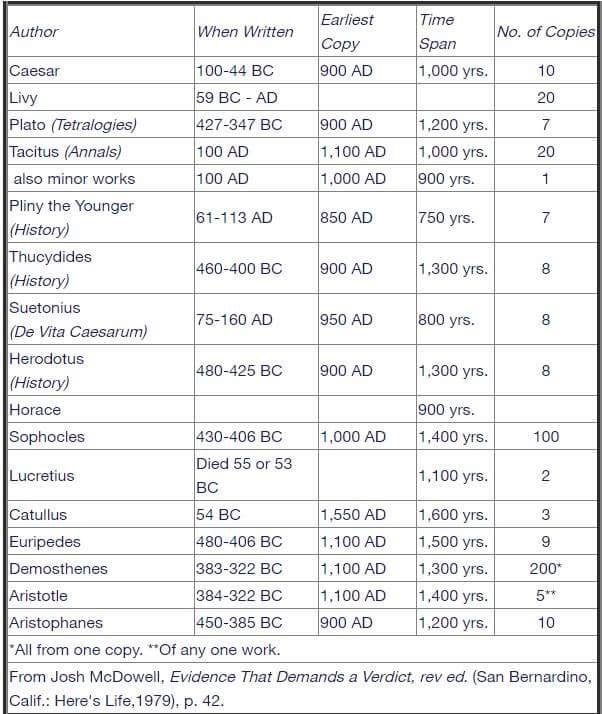
Biblical scripture is in another ballpark compared to other ancient sources yet it receives an an unreasonable amount of skepticism. See the table for contrast to other ancient sources which we trust fully.

A brief perusal of the table indicates that for a representative sample of ancient historical works, we possess only a handful of manuscripts which are, on the average, one thousand years removed from their originals.
In contrast to this, the New Testament documents have a staggering quantity of manuscript attestation. Approximately 5,000 Greek manuscripts, containing all or part of the New Testament, exist. There are 8,000 manuscript copies of the Vulgate (a Latin translation of the Bible done by Jerome from 382–405) and more than 350 copies of Syriac (Christian Aramaic) versions of the New Testament (these originated from 150–250; most of the copies are from the 400s). Besides this, virtually the entire New Testament could be reproduced from citations contained in the works of the early church fathers. There are some thirty-two thousand citations in the writings of the Fathers prior to the Council of Nicea (325).
https://www.bethinking.org/is-the-bible-reliable/the-historicity-of-the-new-testament

Of the four Gospels alone there are 19,368 citations by the church fathers from the late first century on. This includes 268 by Justin Martyr (100-165), 1038 by Irenaeus (active in the late second century), 1017 by Clement of Alexandria (ca. 155-ca. 220), 9231 by Origen (ca. 185-ca. 254), 3822 by Tertullian (ca. 160s-ca. 220), (ca. 160s-ca. 220), 734 by Hippolytus (d. ca. 236), and 3258 by Eusebius (ca. 265-ca.339; Geisler, 431).

Earlier, Clement of Rome cited Matthew, John, and 1 Corinthians, in 95 to 97. Ignatius referred to six Pauline epistles in about 110, and between 110 and 150 Polycarp quoted from all four gospels, Acts, and most of Paul’s epistles. Shepherd of Hermas (115-140) cited Matthew, Mark, Acts, 1 Corinthians, and other books. Didache (120-150) referred to Matthew, Luke, 1 Corinthians, and other books. Papias, companion of Polycarp, who was a disciple of the apostle John, quoted John. This argues powerfully that the gospels were in existence before the end of the first century, while some eyewitnesses (including John) were still alive.
https://www.bethinking.org/bible/the-dating-of-the-new-testament

What is also interesting is how the NT stands in regards to the empirical science of Archeology. So I would strongly recommend going through the following piece that deals with this on the categories of: Culture(Beliefs and Practices), Places (Urban centers and individual buildings) and People (Titles, Names and Relationships):
https://www.bethinking.org/is-the-bible-reliable/archaeology-and-the-historical-reliability-of-the-new-testament

But anyway YES the NT is hands down the most well attested and reliable collection of books of Antiquity.

How Old Was Rebecca When She Was Married To Isaac?

This question is one of the Muslims’ favorites. They just love it, just like they love Luke 19:27 because they think they have found a grave defect in the
Bible, when really all they have done is to misread the text, or maybe more to the point, they haven’t read the text at all.

Muslims insist that Rebecca was three years old when she married Isaac, no doubt an attempt to deflect away from the fact that Aisha herself claimed in the hadith to be six years old when she was betrothed to Muhammad, and nine years
old when he consummated the marriage. To draw attention away from Aisha, they claim that the Bible gives Rebecca’s age as three years old, but if you read the relevant passages you will find there is no such indication of her age. Where
then do the Muslims get this, if not from the Bible? The key is that they misread the text by making the unfounded assumption that Abraham’s binding of
Isaac on the altar, Rebecca’s birth, and Sarah’s death all happened at the same time, thereby compressing time by a decade or more. In this way they are able to remove the gaps in the Bible narrative to arrive at an age of three for Rebecca
at the time of her marriage. But sometimes, it is wise to use a little common sense when trying to cut down a time line to arrive at the results you want.
What the Muslims have done makes no logical sense.

Here is a crude example of how their thinking works: “When I was five years old my parents moved to a new apartment across town to be closer to the school I would attend. Later, I got my driver’s license.” Muslims would use this story t0
prove that I got my driver’s license when I was five years old. Never mind that at five years old my little feet would not have reached the pedals. As silly as
this is, it is exactly what Muslims have done in order to claim that Rebecca was three years old when she was married to Isaac.

But there is more than misreading the Bible. They also draw on the writings of Medieval Jewish Rabbis from the 11th century to make their case. More on that later.

To develop a logical conclusion we should consider four main areas: biblical facts, Islamic traditions, age of consent, and Rabbinic traditions.

BIBLICAL FACTS: Where did the idea that Rebecca was only three years old when
she was married to Isaac come from if it is not in the Bible? Let us first review the facts that we are able to ascertain from the Bible:

(1) Sarah was 90 when Abraham was 100 [Genesis 17:17]. (2) Abraham was 100 when
Isaac was born Genesis 21:5 Sarah died at age 127 Genesis 23:1-2
Isaac was 40 when he married Rebecca [Genesis 25:20]

from these four facts we can infer the following two points:

(5) Sarah was 90 when Isaac was born. [Conclusion drawn from (1) and (2) above.
(6) Isaac was 37 when his mother, Sarah, died [127-90=37]

These six facts do not give us enough information to determine Rebecca’s age when Isaac married her.

TRADITIONS To attempt any calculation of Rebecca’s age, we must make assumptions
not substantiated by Scripture. This is to deny what the Bible says in order to uphold the sought-after results. Jesus warned about making such assumptions in Matthew 15:6, “So for the sake of your tradition you have made void the word of
God.” In other words, to prove that which is not contained in Scripture, you must add something that is not scriptural, such as your own conjecture. The assumptions in the traditions are conjectural and not scripture, and thus not the word of God, but the word of men.

Tradition makes certain assumptions that are not confirmed in Scripture, that the following three events happened at the same time or within a few weeks of each other:

  • The binding of Isaac on the sacrificial altar in Moriah [Genesis 22:9] –
    Abraham informed of Rebecca’s birth [Genesis 22:20-23], quite a stretch of the imagination, to say the least. – Sarah’s death at age 127 [Genesis 23:1-2]

If these three assumptions all did happen at the same time, or within a few weeks, then we can make two more necessary inferences:

(7) Since Isaac was 37 at his mother’s death, this means he was 37 when Rebecca was born. (8) Since Isaac was 40 when Rebecca was born, this means Rebecca was
3 years old when Isaac married her.

(In a similar manner, it was proved that I got my driver’s license at age 5.)

However, the assumptions made in points (7) and (8) are entirely dependent on the assumption that Rebecca was born at the same time that Sarah died. The assumptions in (7) and (8) are spurious because they are based on non-biblical
tradition and not on what the Bible says. The gaps in the narration have been stripped away. If a decade or so had passed between Rebecca’s birth and Sarah’s death, then Rebecca would have been 13. (A young woman [Genesis 24:16]) and not
a three-year old baby. One would not refer to a three-year old baby as a “young woman,” as the Bible does.

To make the case that Rebecca was only three years old at the time of her marriage to Isaac, Muslims have to accept non-biblical traditions and ignore or reject what the Bible says. You might as well forget what the Bible says and make up whatever you want.

Nowhere does the Bible tell us that Abraham’s binding of Isaac, Rebecca’s birth, and Sarah’s death all happened at the same time: – There is no indication of Isaac’s age at the time Abraham bound him on the altar, except to say that Isaac was called a “lad” or a “youth” by Abraham. Would one call a 37-year old man a
“youth”? – Abraham lived at Beersheba after the binding of Isaac. We are not told how long Abraham dwelt at Beersheba. – It was sometime “after these things”
[Genesis 22:20] that Abraham was told that Milcah had borne eight children to his brother, Nahor. We also do not know how long it took this news to reach Abraham. – Notice that when Genesis 22:23 says that “Bethuel begat Rebecca”, this was not part of the news that Abraham received. He was told that Nahor begat Bethuel. The birth of Rebecca was a generation later. We do not know how old Bethuel was when Abraham heard of his birth, nor do we know how old Bethuel
was when Rebecca was born.

The Muslims have taken all of the events above, ignored a generational gap, and compressed 25 years or so down to the same point in time.

AGE OF CONSENT That Rebecca was not a baby of three years is proven by the fact that she had reached the age of consent. This is one of the things that Muslims must ignore because it does not work with their narrative. One does not ask a
three-year old baby if it will agree to marry someone. Consider the evidence:

  • Abraham made his servant swear an oath [Genesis 24:2-9] that “if the woman” (not if the baby) “is not willing to follow you, you will be free from this oath.” [Genesis 24:8]. In other words the woman (not a baby) must be willing to
    go to Isaac and that the marriage was to be at her consent. -Rebecca’s family also asked her if she would consent to go. Her mother and her brother, Laban, asked Rebecca if she would be willing: “And they said, ‘We will call the girl and ask her to speak her wishes by her own mouth.’ Then they called the girl and said, ‘Will you go with this man?’ And she said, ‘I will go.’ ” [Genesis 24:56-59] This does not prove her age but it does prove that she had reached the age of consent.

Then Rebecca mounted a camel and followed the man, together with her “nurse” [Genesis 24:59]. Her nurse was named Deborah. [Genesis 35:8]. The word nurse means a maidservant, or handmaiden, who was also responsible for her education.
This does not imply that this person was a nurse to a baby as Muslims insist. A lady of rank is, on her marriage, always accompanied by a nurse, who, as a confidential servant, is held in great regard by the family.

It is hard to image a three-year old baby mounting a camel, as it is equally hard to imagine a baby drawing a few hundred pounds of water from a well sufficient for 10 or 20 camels.

RABBINICAL TRADITION By the 1300s, Islam had spread across North Africa and into Spain. Muslims rely on the speculation of several rabbis, writing about 2,000 years after the events in question. These rabbis used unscriptural assumption to arrive at an age for Rebecca, and it is their writings that are the basis for Muslims’ assertion that Rebecca was only three years old. Their writings, however, are not accepted as scriptural. I suspect that they arrived at their
conclusions at the behest of their Muslim overlords.

I submit these as reference for anyone who might want to check it out for themselves:

Genesis Rabba (Midrash Rabbah) Rabbi Abraham Cohen de Herrera (1570-1635 AD)
Rabbi Rashbam (1085-1158 AD) Targum Jonathan

351 Old Testament Prophecies Fulfilled by Jesus Christ

ProphecyDescriptionFulfillment
1. Gen 3:15Seed of a woman (virgin birth)Gal 4:4-5; Matt 1:18
2. Gen 3:15He will bruise Satan’s headHeb 2:14; 1 John 3:8
3. Gen 5:24The bodily ascension to heaven illustratedMark 16:19
4. Gen 9:26-27The God of Shem will be the Son of ShemLuke 3:36
5. Gen 12:3Seed of Abraham will bless all nationsGal 3:8; Acts 3:25-26
6. Gen 12:7The Promise made to Abraham’s SeedGal 3:16
7. Gen 14:18A priest after the order of MelchizedekHeb 6:20
8. Gen 14:18King of Peace and RighteousnessHeb 7:2
9. Gen 14:18The Last Supper foreshadowedMatt 26:26-29
10. Gen 17:19Seed of Isaac (Gen 21:12)Rom 9:7
11. Gen 22:8The Lamb of God promisedJohn 1:29
12. Gen 22:18As Isaac’s seed, will bless all nationsGal 3:16
13. Gen 26:2-5The Seed of Isaac promised as the RedeemerHeb 11:18
14. Gen 28:12The Bridge to heavenJohn 1:51
15. Gen 28:14The Seed of JacobLuke 3:34
16. Gen 49:10The time of His comingLuke 2:1-7; Gal 4:4
17. Gen 49:10The Seed of JudahLuke 3:33
18. Gen 49:10Called Shiloh or One SentJohn 17:3
19. Gen 49:10Messiah to come before Judah lost identityJohn 11:47-52
20. Gen 49:10Unto Him shall the obedience of the people beJohn 10:16
21. Ex 3:13-15The Great “I AM”John 4:26; 8:58
22. Ex 12:5A Lamb without blemishHeb 9:14; 1 Pet 1:19
23. Ex 12:13The blood of the Lamb saves from wrathRom 5:8
24. Ex 12:21-27Christ is our Passover1 Cor 5:7
25. Ex 12:46Not a bone of the Lamb to be brokenJohn 19:31-36
26. Ex 15:2His exaltation predicted as YeshuaActs 7:55-56
27. Ex 15:11His Character-HolinessLuke 1:35; Acts 4:27
28. Ex 17:6The Spiritual Rock of Israel1 Cor 10:4
29. Ex 33:19His Character-MercifulLuke 1:72
30. Lev 1:2-9His sacrifice a sweet smelling savor unto GodEph 5:2
31. Lev 14:11The leper cleansed-Sign to priesthoodLuke 5:12-14; Acts 6:7
32. Lev 16:15-17Prefigures Christ’s once-for-all deathHeb 9:7-14
33. Lev 16:27Suffering outside the CampMatt 27:33; Heb. 13:11-12
34. Lev 17:11The Blood-the life of the fleshMatt 26:28; Mark 10:45
35. Lev 17:11It is the blood that makes atonementRom. 3:23-24; 1 John 1:7
36. Lev 23:36-37The Drink-offering: “If any man thirst”John 7:37
37. Num 9:12Not a bone of Him brokenJohn 19:31-36
38. Num 21:9The serpent on a pole-Christ lifted upJohn 3:14-18; 12:32
39. Num 24:17Time: “I shall see him, but not now.”John 1:14; Gal 4:4
40. Deut 18:15“This is of a truth that prophet”John 6:14
41. Deut 18:15-16“Had you believed Moses, you would believe me.”John 5:45-47
42. Deut 18:18Sent by the Father to speak His wordJohn 8:28-29
43. Deut 18:19Whoever will not hear must bear his sinActs 3:22-23
44. Deut 21:23Cursed is he that hangs on a treeGal 3:10-13
45. Joshua 5:14-15The Captain of our salvationHeb 2:10
46. Ruth 4:4-10Christ, our kinsman, has redeemed usEph 1:3-7
47. 1 Sam 2:35A Faithful PriestHeb. 2:17; 3:1-3, 6; 7:24-25
48. 1 Sam 2:10Shall be an anointed King to the LordMatt 28:18; John 12:15
49. 2 Sam 7:12David’s SeedMatt 1:1
50. 2 Sam 7:13His Kingdom is everlasting2 Pet 1:11
51. 2 Sam 7:14aThe Son of GodLuke 1:32; Rom 1:3-4
52. 2 Sam 7:16David’s house established foreverLuke 3:31; Rev 22:16
53. 2 Ki 2:11The bodily ascension to heaven illustratedLuke 24:51
54. 1 Chr 17:11David’s SeedMatt 1:1; 9:27
55. 1 Chr 17:12-13To reign on David’s throne foreverLuke 1:32-33
56. 1 Chr 17:13“I will be His Father, He…my Son.”Heb 1:5
57. Job 9:32-33Mediator between man and God1 Tim 2:5
58. Job 19:23-27The Resurrection predictedJohn 5:24-29
59. Psa 2:1-3The enmity of kings foreordainedActs 4:25-28
60. Psa 2:2To own the title, Anointed (Christ)John 1:41; Acts 2:36
61. Psa 2:6His Character-HolinessJohn 8:46; Rev 3:7
62. Psa 2:6To own the title KingMatt 2:2
63. Psa 2:7Declared the Beloved SonMatt 3:17; Rom 1:4
64. Psa 2:7-8The Crucifixion and Resurrection intimatedActs 13:29-33
65. Psa 2:8-9Rule the nations with a rod of ironRev 2:27; 12:5; 19:15
66. Psa 2:12Life comes through faith in HimJohn 20:31
67. Psa 8:2The mouths of babes perfect His praiseMatt 21:16
68. Psa 8:5-6His humiliation and exaltationHeb 2:5-9
69. Psa 9:7-10Judge the world in righteousnessActs 17:31
70. Psa 16:10Was not to see corruptionActs 2:31; 13:35
71. Psa 16:9-11Was to arise from the deadJohn 20:9
72. Psa 17:15The resurrection predictedLuke 24:6
73. Psa 18:2-3The horn of salvationLuke 1:69-71
74. Psa 22:1Forsaken because of sins of others2 Cor 5:21
75. Psa 22:1“My God, my God, why have You forsaken me?”Matt 27:46
76. Psa 22:2Darkness upon Calvary for three hoursMatt 27:45
77. Psa 22:7They shoot out the lip and shake the headMatt 27:39-44
78. Psa 22:8“He trusted in God, let Him deliver Him”Matt 27:43
79. Psa 22:9-10Born the SaviorLuke 2:7
80. Psa 22:12-13They seek His deathJohn 19:6
81. Psa 22:14His blood poured out when they pierced His sideJohn 19:34
82. Psa 22:14-15Suffered agony on CalvaryMark 15:34-37
83. Psa 22:15He thirstedJohn 19:28
84. Psa 22:16They pierced His hands and His feetJohn 19:34-37; 20:27
85. Psa 22:17-18Stripped Him before the stares of menLuke 23:34-35
86. Psa 22:18They parted His garmentsJohn 19:23-24
87. Psa 22:20-21He committed Himself to GodLuke 23:46
88. Psa 22:20-21Satanic power bruising the Redeemer’s heelHeb 2:14
89. Psa 22:22His Resurrection declaredJohn 20:17
90. Psa 22:27-28He shall be the governor of the nationsCol 1:16
91. Psa 22:31“It is finished”John 19:30; Heb 10:10-12, 14, 18
92. Psa 23:1“I am the Good Shepherd”John 10:11; 1 Pet 2:25
93. Psa 24:3His exaltation predictedActs 1:11; Phil 2:9
94. Psa 30:3His resurrection predictedActs 2:32
95. Psa 31:5“Into Your hands I commit my spirit”Luke 23:46
96. Psa 31:11His acquaintances fled from HimMark 14:50
97. Psa 31:13They took counsel to put Him to deathMatt 27:1; John 11:53
98. Psa 31:14-15“He trusted in God, let Him deliver him”Matt 27:43
99. Psa 34:20Not a bone of Him brokenJohn 19:31-36
100. Psa 35:11False witnesses rose up against HimMatt 26:59
101. Psa 35:19He was hated without a causeJohn 15:25
102. Psa 38:11His friends stood afar offLuke 23:49
103. Psa 38:12Enemies try to entangle Him by craftMark 14:1; Matt 22:15
104. Psa 38:12-13Silent before His accusersMatt 27:12-14
105. Psa 38:20He went about doing goodActs 10:38
106. Psa 40:2-5The joy of His resurrection predictedJohn 20:20
107. Psa 40:6-8His delight-the will of the FatherJohn 4:34; Heb 10:5-10
108. Psa 40:9He was to preach the Righteousness in IsraelMatt 4:17
109. Psa 40:14Confronted by adversaries in the GardenJohn 18:4-6
110. Psa 41:9Betrayed by a familiar friendJohn 13:18
111. Psa 45:2Words of Grace come from His lipsJohn 1:17; Luke 4:22
112. Psa 45:6To own the title, God or ElohimHeb 1:8
113. Psa 45:7A special anointing by the Holy SpiritMatt 3:16; Heb. 1:9
114. Psa 45:7-8Called the Christ (Messiah or Anointed)Luke 2:11
115. Psa 45:17His name remembered foreverEph 1:20-21; Heb. 1:8
116. Psa 55:12-14Betrayed by a friend, not an enemyJohn 13:18
117. Psa 55:15Unrepentant death of the BetrayerMatt 27:3-5; Acts 1:16-19
118. Psa 68:18To give gifts to menEph 4:7-16
119. Psa 68:18Ascended into HeavenLuke 24:51
120. Psa 69:4Hated without a causeJohn 15:25
121. Psa 69:8A stranger to own brethrenJohn 1:11; 7:5
122. Psa 69:9Zealous for the Lord’s HouseJohn 2:17
123. Psa 69:14-20Messiah’s anguish of soul before crucifixionMatt 26:36-45
124. Psa 69:20“My soul is exceeding sorrowful”Matt 26:38
125. Psa 69:21Given vinegar in thirstMatt 27:34
126. Psa 69:26The Savior given and smitten by GodJohn 17:4; 18:11
127. Psa 72:10-11Great persons were to visit HimMatt 2:1-11
128. Psa 72:16The corn of wheat to fall into the GroundJohn 12:24-25
129. Psa 72:17Belief on His name will produce offspringJohn 1:12-13
130. Psa 72:17All nations shall be blessed by HimGal 3:8
131. Psa 72:17All nations shall call Him blessedJohn 12:13; Rev 5:8-12
132. Psa 78:1-2He would teach in parablesMatt 13:34-35
133. Psa 78:2bTo speak the Wisdom of God with authorityMatt 7:29
134. Psa 80:17The Man of God’s right handMark 14:61-62
135. Psa 88The Suffering and Reproach of CalvaryMatt 27:26-50
136. Psa 88:8They stood afar off and watchedLuke 23:49
137. Psa 89:27FirstbornCol 1:15-18
138. Psa 89:27Emmanuel to be higher than earthly kingsLuke 1:32-33
139. Psa 89:35-37David’s Seed, throne, kingdom endure foreverLuke 1:32-33
140. Psa 89:36-37His character-FaithfulnessRev 1:5; 19:11
141. Psa 90:2He is from everlasting (Micah 5:2)John 1:1
142. Psa 91:11-12Identified as Messianic, used to tempt ChristLuke 4:10-11
143. Psa 97:9His exaltation predictedActs 1:11; Eph 1:20
144. Psa 100:5His character-GoodnessMatt 19:16-17
145. Psa 102:1-11The Suffering and Reproach of CalvaryJohn 19:16-30
146. Psa 102:25-27Messiah is the Preexistent SonHeb 1:10-12
147. Psa 109:25RidiculedMatt 27:39
148. Psa 110:1Son of DavidMatt 22:42-43
149. Psa 110:1To ascend to the right-hand of the FatherMark 16:19
150. Psa 110:1David’s son called LordMatt 22:44-45
151. Psa 110:4A priest after Melchizedek’s orderHeb 6:20
152. Psa 112:4His character-Compassionate, Gracious, et alMatt 9:36
153. Psa 118:17-18Messiah’s Resurrection assuredLuke 24:5-7; 1 Cor 15:20
154. Psa 118:22-23The rejected stone is Head of the cornerMatt 21:42-43
155. Psa 118:26aThe Blessed One presented to IsraelMatt 21:9
156. Psa 118:26bTo come while Temple standingMatt 21:12-15
157. Psa 132:11The Seed of David (the fruit of His Body)Luke 1:32; Act 2:30
158. Psa 129:3He was scourgedMatt 27:26
159. Psa 138:1-6The supremacy of David’s Seed amazes kingsMatt 2:2-6
160. Psa 147:3-6The earthly ministry of Christ describedLuke 4:18
161. Prov 1:23He will send the Spirit of GodJohn 16:7
162. Prov 8:23Foreordained from everlastingRev 13:8; 1 Pet 1:19-20
163. Song 5:16The altogether lovely OneJohn 1:17
164. Isa 2:3He shall teach all nationsJohn 4:25
165. Isa 2:4He shall judge among the nationsJohn 5:22
166. Isa 6:1When Isaiah saw His gloryJohn 12:40-41
167. Isa 6:8The One Sent by GodJohn 12:38-45
168. Isa 6:9-10Parables fall on deaf earsMatt 13:13-15
169. Isa 6:9-12Blinded to Christ and deaf to His wordsActs 28:23-29
170. Isa 7:14To be born of a virginLuke 1:35
171. Isa 7:14To be Emmanuel-God with usMatt 1:18-23; 1 Tim 3:16
172. Isa 8:8Called EmmanuelMatt 28:20
173. Isa 8:14A stone of stumbling, a Rock of offense1 Pet 2:8
174. Isa 9:1-2His ministry to begin in GalileeMatt 4:12-17
175. Isa 9:6A child born-HumanityLuke 1:31
176. Isa 9:6A Son given-DeityLuke 1:32; John 1:14; 1 Tim 3:16
177. Isa 9:6Declared to be the Son of God with powerRom 1:3-4
178. Isa 9:6The Wonderful One, PelehLuke 4:22
179. Isa 9:6The Counselor, YaatzMatt 13:54
180. Isa 9:6The Mighty God, El Gibor1 Cor 1:24; Titus 2:3
181. Isa 9:6The Everlasting Father, Avi AdthJohn 8:58; 10:30
182. Isa 9:6The Prince of Peace, Sar ShalomJohn 16:33
183. Isa 9:7To establish an everlasting kingdomLuke 1:32-33
184. Isa 9:7His Character-JustJohn 5:30
185. Isa 9:7No end to his Government, Throne, and PeaceLuke 1:32-33
186. Isa 11:1Called a Nazarene-the Branch, NetzerMatt 2:23
187. Isa 11:1A rod out of Jesse-Son of JesseLuke 3:23-32
188. Isa 11:2Anointed One by the SpiritMatt 3:16-17; Acts 10:38
189. Isa 11:2His Character-Wisdom, Knowledge, et alCol 2:3
190. Isa 11:3He would know their thoughtsLuke 6:8; John 2:25
191. Isa 11:4Judge in righteousnessActs 17:31
192. Isa 11:4Judges with the sword of His mouthRev 2:16; 19:11, 15
193. Isa 11:5Character: Righteous & FaithfulRev 19:11
194. Isa 11:10The Gentiles seek HimJohn 12:18-21
195. Isa 12:2Called Jesus-YeshuaMatt 1:21
196. Isa 22:22The One given all authority to governRev 3:7
197. Isa 25:8The Resurrection predicted1 Cor 15:54
198. Isa 26:19His power of Resurrection predictedMatt 27:50-54
199. Isa 28:16The Messiah is the precious corner stoneActs 4:11-12
200. Isa 28:16The Sure Foundation1 Cor 3:11; Matt 16:18
201. Isa 29:13He indicated hypocritical obedience to His WordMatt 15:7-9
202. Isa 29:14The wise are confounded by the Word1 Cor 1:18-31
203. Isa 32:2A Refuge-A man shall be a hiding placeMatt 23:37
204. Isa 35:4He will come and save youMatt 1:21
205. Isa 35:5-6To have a ministry of miraclesMatt 11:2-6
206. Isa 40:3-4Preceded by forerunnerJohn 1:23
207. Isa 40:9“Behold your God”John 1:36; 19:14
208. Isa 40:10He will come to rewardRev 22:12
209. Isa 40:11A shepherd-compassionate life-giverJohn 10:10-18
210. Isa 42:1-4The Servant-as a faithful, patient redeemerMatt 12:18-21
211. Isa 42:2Meek and lowlyMatt 11:28-30
212. Isa 42:3He brings hope for the hopelessJohn 4
213. Isa 42:4The nations shall wait on His teachingsJohn 12:20-26
214. Isa 42:6The Light (salvation) of the GentilesLuke 2:32
215. Isa 42:1-6His is a worldwide compassionMatt 28:19-20
216. Isa 42:7Blind eyes openedJohn 9:25-38
217. Isa 43:11He is the only SaviorActs 4:12
218. Isa 44:3He will send the Spirit of GodJohn 16:7-13
219. Isa 45:21-25He is Lord and SaviorPhil 3:20; Titus 2:13
220. Isa 45:23He will be the JudgeJohn 5:22; Rom 14:11
221. Isa 46:9-10Declares things not yet doneJohn 13:19
222. Isa 48:12The First and the LastJohn 1:30; Rev 1:8, 17
223. Isa 48:16-17He came as a TeacherJohn 3:2
224. Isa 49:1Called from the womb-His humanityMatt 1:18
225. Isa 49:5A Servant from the wombLuke 1:31; Phil 2:7
226. Isa 49:6He will restore IsraelActs 3:19-21; 15:16-17
227. Isa 49:6He is Salvation for IsraelLuke 2:29-32
228. Isa 49:6He is the Light of the GentilesJohn 8:12; Acts 13:47
229. Isa 49:6He is Salvation unto the ends of the earthActs 15:7-18
230. Isa 49:7He is despised of the NationJohn 1:11; 8:48-49; 19:14-15
231. Isa 50:3Heaven is clothed in black at His humiliationLuke 23:44-45
232. Isa 50:4He is a learned counselor for the wearyMatt 7:29; 11:28-29
233. Isa 50:5The Servant bound willingly to obedienceMatt 26:39
234. Isa 50:6a“I gave my back to those who struck Me”Matt 27:26
235. Isa 50:6bHe was smitten on the cheeksMatt 26:67
236. Isa 50:6cHe was spat uponMatt 27:30
237. Isa 52:7Published good tidings upon mountainsMatt 5:12; 15:29; 28:16
238. Isa 52:13The Servant exaltedActs 1:8-11; Eph 1:19-22; Phil 2:5-9
239. Isa 52:14The Servant shockingly abusedLuke 18:31-34; Matt 26:67-68
240. Isa 52:15Nations startled by message of the ServantLuke 18:31-34; Matt 26:67-68
241. Isa 52:15His blood shed sprinkles nationsHeb 9:13-14; Rev 1:5
242. Isa 53:1His people would not believe HimJohn 12:37-38
243. Isa 53:2Appearance of an ordinary manPhil 2:6-8
244. Isa 53:3aDespisedLuke 4:28-29
245. Isa 53:3bRejectedMatt 27:21-23
246. Isa 53:3cGreat sorrow and griefMatt 26:37-38; Luke 19:41; Heb 4:15
247. Isa 53:3dMen hide from being associated with HimMark 14:50-52
248. Isa 53:4aHe would have a healing ministryMatt 8:16-17
249. Isa 53:4bThought to be cursed by GodMatt 26:66; 27:41-43
250. Isa 53:5aBears penalty for mankind’s iniquities2 Cor 5:21; Heb 2:9
251. Isa 53:5bHis sacrifice provides peace between man and GodCol 1:20
252. Isa 53:5cHis sacrifice would heal man of sin1 Pet 2:24
253. Isa 53:6aHe would be the sin-bearer for all mankind1 John 2:2; 4:10
254. Isa 53:6bGod’s will that He bear sin for all mankindGal 1:4
255. Isa 53:7aOppressed and afflictedMatt 27:27-31
256. Isa 53:7bSilent before his accusersMatt 27:12-14
257. Isa 53:7cSacrificial lambJohn 1:29; 1 Pet 1:18-19
258. Isa 53:8aConfined and persecutedMatt 26:47-27:31
259. Isa 53:8bHe would be judgedJohn 18:13-22
260. Isa 53:8cKilledMatt 27:35
261. Isa 53:8dDies for the sins of the world1 John 2:2
262. Isa 53:9aBuried in a rich man’s graveMatt 27:57
263. Isa 53:9bInnocent and had done no violenceLuke 23:41; John 18:38
264. Isa 53:9cNo deceit in his mouth1 Pet 2:22
265. Isa 53:10aGod’s will that He die for mankindJohn 18:11
266. Isa 53:10bAn offering for sinMatt 20:28; Gal 3:13
267. Isa 53:10cResurrected and live foreverRom 6:9
268. Isa 53:10dHe would prosperJohn 17:1-5
269. Isa 53:11aGod fully satisfied with His sufferingJohn 12:27
270. Isa 53:11bGod’s servant would justify manRom 5:8-9, 18-19
271. Isa 53:11cThe sin-bearer for all mankindHeb 9:28
272. Isa 53:12aExalted by God because of his sacrificeMatt 28:18
273. Isa 53:12bHe would give up his life to save mankindLuke 23:46
274. Isa 53:12cNumbered with the transgressorsMark 15:27-28
275. Isa 53:12dSin-bearer for all mankind1 Pet 2:24
276. Isa 53:12eIntercede to God in behalf of mankindLuke 23:34; Rom 8:34
277. Isa 55:3Resurrected by GodActs 13:34
278. Isa 55:4aA witnessJohn 18:37
279. Isa 55:4bHe is a leader and commanderHeb 2:10
280. Isa 55:5God would glorify HimActs 3:13
281. Isa 59:16aIntercessor between man and GodMatt 10:32
282. Isa 59:16bHe would come to provide salvationJohn 6:40
283. Isa 59:20He would come to Zion as their RedeemerLuke 2:38
284. Isa 60:1-3He would show light to the GentilesActs 26:23
285. Isa 61:1aThe Spirit of God upon himMatt 3:16-17
286. Isa 61:1bThe Messiah would preach the good newsLuke 4:16-21
287. Isa 61:1cProvide freedom from the bondage of sinJohn 8:31-36
288. Isa 61:1-2aProclaim a period of graceGal 4:4-5
289. Jer 23:5-6Descendant of DavidLuke 3:23-31
290. Jer 23:5-6The Messiah would be both God and ManJohn 13:13; 1 Tim 3:16
291. Jer 31:22Born of a virginMatt 1:18-20
292. Jer 31:31The Messiah would be the new covenantMatt 26:28
293. Jer 33:14-15Descendant of DavidLuke 3:23-31
294. Ezek 34:23-24Descendant of DavidMatt 1:1
295. Ezek 37:24-25Descendant of DavidLuke 1:31-33
296. Dan 2:44-45The Stone that shall break the kingdomsMatt 21:44
297. Dan 7:13-14aHe would ascend into heavenActs 1:9-11
298. Dan 7:13-14bHighly exaltedEph 1:20-22
299. Dan 7:13-14cHis dominion would be everlastingLuke 1:31-33
300. Dan 9:24aTo make an end to sinsGal 1:3-5
301. Dan 9:24aTo make reconciliation for iniquityRom 5:10; 2 Cor 5:18-21
302. Dan 9:24bHe would be holyLuke 1:35
303. Dan 9:25His announcementJohn 12:12-13
304. Dan 9:26aCut offMatt 16:21; 21:38-39
305. Dan 9:26bDie for the sins of the worldHeb 2:9
306. Dan 9:26cKilled before the destruction of the templeMatt 27:50-51
307. Dan 10:5-6Messiah in a glorified stateRev 1:13-16
308. Hos 11:1He would be called out of EgyptMatt 2:15
309. Hos 13:14He would defeat death1 Cor 15:55-57
310. Joel 2:32Offer salvation to all mankindRom 10:9-13
311. Jonah 1:17Death and resurrection of ChristMatt 12:40; 16:4
312. Mic 5:2aBorn in BethlehemMatt 2:1-6
313. Mic 5:2bRuler in IsraelLuke 1:33
314. Mic 5:2cFrom everlastingJohn 8:58
315. Hag 2:6-9He would visit the second TempleLuke 2:27-32
316. Hag 2:23Descendant of ZerubbabelLuke 2:27-32
317. Zech 3:8God’s servantJohn 17:4
318. Zech 6:12-13Priest and KingHeb 8:1
319. Zech 9:9aGreeted with rejoicing in JerusalemMatt 21:8-10
320. Zech 9:9bBeheld as KingJohn 12:12-13
321. Zech 9:9cThe Messiah would be justJohn 5:30
322. Zech 9:9dThe Messiah would bring salvationLuke 19:10
323. Zech 9:9eThe Messiah would be humbleMatt 11:29
324. Zech 9:9fPresented to Jerusalem riding on a donkeyMatt 21:6-9
325. Zech 10:4The cornerstoneEph 2:20
326. Zech 11:4-6aAt His coming, Israel to have unfit leadersMatt 23:1-4
327. Zech 11:4-6bRejection causes God to remove His protectionLuke 19:41-44
328. Zech 11:4-6cRejected in favor of another kingJohn 19:13-15
329. Zech 11:7Ministry to “poor,” the believing remnantMatt 9:35-36
330. Zech 11:8aUnbelief forces Messiah to reject themMatt 23:33
331. Zech 11:8bDespisedMatt 27:20
332. Zech 11:9Stops ministering to those who rejected HimMatt 13:10-11
333. Zech 11:10-11aRejection causes God to remove protectionLuke 19:41-44
334. Zech 11:10-11bThe Messiah would be GodJohn 14:7
335. Zech 11:12-13aBetrayed for thirty pieces of silverMatt 26:14-15
336. Zech 11:12-13bRejectedMatt 26:14-15
337. Zech 11:12-13cThirty pieces of silver cast in the house of the LordMatt 27:3-5
338. Zech 11:12-13dThe Messiah would be GodJohn 12:45
339. Zech 12:10aThe Messiah’s body would be piercedJohn 19:34-37
340. Zech 12:10bThe Messiah would be both God and manJohn 10:30
341. Zech 12:10cThe Messiah would be rejectedJohn 1:11
342. Zech 13:7aGod’s will He die for mankindJohn 18:11
343. Zech 13:7bA violent deathMark 14:27
344. Zech 13:7cBoth God and manJohn 14:9
345. Zech 13:7dIsrael scattered as a result of rejecting HimMatt 26:31-56
346. Zech 14:4He would return to the Mt. of OlivesActs 1:11-12
347. Mal 3:1aMessenger to prepare the way for MessiahMark 1:1-8
348. Mal 3:1bSudden appearance at the templeMark 11:15-16
349. Mal 3:1cMessenger of the new covenantLuke 4:43
350. Mal 4:5Forerunner in spirit of ElijahMatt 3:1-3; 11:10-14; 17:11-13
351. Mal 4:6Forerunner would turn many to righteousnessLuke 1:16-17

God’s Land Covenant With Israel

GOD’S LAND COVENANT WITH ISRAEL

On another thread the Muslim Adamu Bakari Bn Abubaker said:

“Stop lying Palestine only used stone against invader who wanted to steal their country.

Israel are bombarding them daily

Israel never existed before 1945.”

This comment is representative of the myopic and incorrect view of Israel from her enemies. The purpose of the post is to set the record straight. At the same time we shall expose a monumental error in the Quran.

1). INTRODUCTION

The so-called “Palestinian” Covenant is recorded in Deuteronomy 29:1–29 and Deuteronomy 30:1–10 and was made between God and Israel right before Moses died and Israel entered the Promised Land. The Bible never uses the term “Palestinian Covenant,” and Moses certainly never would have called the land “Palestine,” but the term has become common usage. This is unfortunate for 2 reasons.

First: it was a name given to the land by the Roman Emperor Hadrian after the Second Jewish Revolt under Bar Cochba (A.D. 132-135). His purpose was to erase any Jewish remembrance of the Land as part of his policy to “de judaize” the Land.

Second: due to the historical events in the Middle East in the history of modern Israel, the name is associated more with Arabs than with Jews. A better title for this covenant would have been the “Land Covenant” since “Palestine” is not a biblical designation anyway. For the purposes of this Post I will refer to it by the alternative name the Land Covenant which it is also called because many of the promises relate to Israel’s possession of the land.

[See Footnotes for an explanation of how Palestine appears in modern Bibles].

2). BIBLICAL REFERENCES

God made the Land Covenant with Israel after the Mosaic Covenant and after Israel had wandered in the wilderness for forty years while they were in Moab waiting to go into the Promised Land. The covenant would serve this new generation of Israelites as a reminder of their special covenant relationship with God.

The Land Covenant has many similarities to the Mosaic Covenant made at Mount Sinai but is a separate and distinct covenant as clearly seen in Deuteronomy 29:1:

“These are the words of the covenant which the Lord commanded Moses to make with the children of Israel in the land of Moab, BESIDES THE COVENANT which He made with them in Horeb.”

Before making this covenant with Israel, God reminded them that if they obeyed the Mosaic Law, He would bless the nation abundantly and warned them that disobedience to the Law would result in His cursing the nation. (Deuteronomy 28:1-68).

We must go back to Genesis 12 to trace the origin of God’s promise to Abraham (Abram) of land:

“The Lord said to Abram: Go out from your land, your relatives, and your father’s house to the land that I will show you. He took his wife Sarai, his nephew Lot, all the possessions they had accumulated, and the people he had acquired in Haran, and they set out for the land of Canaan. When they came to the land of Canaan, Abram passed through the land to the site of Shechem, at the oak of Moreh. At that time the Canaanites were in the land. Then the Lord appeared to Abram and said, “I will give this land to your offspring.” So he built an altar there to the Lord who had appeared to him.” (Genesis 12:1, 5-7 HCSB)

And we must look to the book of Exodus to find God had already set the boundaries for the promised land:

“I will set your borders from the Red Sea to the Mediterranean Sea, and from the wilderness to the Euphrates River. For I will place the inhabitants of the land under your control, and you will drive them out ahead of you.” (Exodus 23:31 HCSB)

It’s worth noting that this encompasses an area far larger than present day Israel.

Deuteronomy 30:1-10 describes some of the provisions of the Land Covenant:

“When all these things happen to you — the blessings and curses I have set before you — and you come to your senses while you are in all the nations where the Lord your God has driven you,  and you and your children return to the Lord your God and obey Him with all your heart and all your soul by doing everything I am giving you today, then He will restore your fortunes,  have compassion on you, and gather you again from all the peoples where the Lord your God has scattered you. Even if your exiles are at the ends of the earth, He will gather you and bring you back from there. The Lord your God will bring you into the land your fathers possessed, and you will take possession of it. He will cause you to prosper and multiply you more than He did your fathers. The Lord your God will circumcise your heart and the hearts of your descendants, and you will love Him with all your heart and all your soul so that you will live.  The Lord your God will put all these curses on your enemies who hate and persecute you. Then you will again obey Him and follow all His commands I am giving you today. The Lord your God will make you prosper abundantly in all the work of your hands with children, the offspring of your livestock, and your land’s produce. Indeed, the Lord will again delight in your prosperity, as He delighted in that of your fathers, when you obey the Lord your God by keeping His commands and statutes that are written in this book of the law and return to Him with all your heart and all your soul.” (Deuteronomy 30:1-10 HCSB)

3). THE PARTICIPANTS IN THE COVENANT

This covenant was made between God and Israel, the same two parties as in the Mosaic Covenant.

4). THE PROVISIONS OF THE COVENANT

Eight provisions can be gleaned from this passage.

□ First: Moses spoke prophetically of Israel’s coming disobedience to the Mosaic Law and her subsequent scattering over all the world (29:2-30:1). All remaining provisions speak of various facets of Israel’s final restoration.

□ Second: Israel will repent (30:2).

□ Third: the Messiah will return (v. 3a).

□ Fourth: Israel will be regathered (vv. 3b-4).

□ Fifth: Israel will possess the Promised Land (v. 5).

□ Sixth: Israel will be regenerated (v. 6).

□ Seventh: the enemies of Israel will be judged (v. 7).

□ Eighth: Israel will receive full blessing; specifically, the blessings of the Messianic Age (vv. 8-20).

5). THE IMPORTANCE OF THE COVENANT

The special importance of the Land Covenant is that it reaffirms the title deed to the Land as belonging to Israel. Although she would prove unfaithful and disobedient, the right to the Land would never be taken from her. Furthermore, it shows that the conditional Mosaic Covenant did not lay aside the unconditional Abrahamic Covenant. It might be taken by some that the Mosaic Covenant displaced the Abrahamic Covenant, but the Land Covenant shows that this is not true. The Land Covenant is an enlargement of the original Abrahamic Covenant. It amplifies the Land aspect and emphasizes the promise of the Land to God’s earthly Jewish people in spite of their unbelief. The Abrahamic Covenant teaches that ownership for the Land is unconditional while the Land Covenant teaches that the enjoyment of the Land is conditioned on obedience.

6). THE PRESENT DAY STATUS OF THE COVENANT

The Land Covenant, being an unconditional covenant, is still very much in effect.

We can see proof of this in prophecy fulfilment to the present day.

Israel, a nation that had not really existed as a separate nation for nearly 2,500 years, was declared a new sovereign state by an act of the United Nations on May 14, 1948. The nation was born in a day. Isaiah predicted it:

“Who has heard of such a thing? Who has seen such things? Can a land be born in one day or a nation be delivered in an instant? Yet as soon as Zion was in labor, she gave birth to her sons.” (Isaiah 66:8)

Even the order of the return the Bible accurately predicts. The first returning Jews to Palestine came primarily from eastern Arab countries. The next major movement came from the western countries of Europe, especially Germany. Then they came in great numbers from Russia (north) during the end of the 1980’s. The last great migrations of Jews returning to Israel came from Ethiopia in the south. This precise order of return was predicted by Isaiah:

“Do not be afraid, for I am with you; I will bring your children from the east and gather you from the west. I will say to the north, `Give them up!’ and to the south, `Do not hold them back.’ Bring my sons from afar and my daughters from the ends of the earth…”

“… the people I formed for myself that they may proclaim my praise.” (Isaiah 43:5-6 & 21)

Let the redeemed of the Lord proclaim that He has redeemed them from the hand of the foe and has gathered them from the lands — from the east and the west, from the north and the south.” (Psalms 107:2-3)

7). THE QURAN’S POSITION

It should come as no surprise that the Quran is completely at odds with the Bible. It actually teaches that the Promised Land which Israel was to inherit was Egypt!

Before presenting the evidence for this note that the words Canaan, Israel (the land, not the people), Judea or Jerusalem never appear in the Quran, which is truly bewildering and astonishing to say the least.

When the Quran does speak of Israel’s inheritance it simply refers to the land or city which God gave them. For instance:

“And (remember) when Moses said unto his people: O my people! Remember Allah’s favour unto you, how He placed among you prophets, and He made you kings, and gave you that (which) He gave not to any (other) of (His) creatures. O my people! Go into the holy land which Allah hath ordained for you. Turn not in flight, for surely ye turn back as losers: They said: O Moses! Lo! a giant people (dwell) therein and lo! we go not in till they go forth from thence. When they go forth from thence, then we will enter (not till then). Then out spake two of those who feared (their Lord, men) unto whom Allah had been gracious: Enter in upon them by the gate, for if ye enter by it, lo! ye will be victorious. So put your trust (in Allah) if ye are indeed believers. They said: O Moses! We will never enter (the land) while they are in it. So go thou and thy Lord and fight! We will sit here. He said: My Lord! I have control of none but myself and my brother, so distinguish between us and the wrong-doing folk. (Their Lord) said: For this the land will surely be forbidden them for forty years that they will wander in the earth, bewildered. So grieve not over the wrongdoing folk.” (Surah  5:20-26 Pickthall)

The text doesn’t identify exactly where this holy land was situated, who these giants were, or which two men feared their Lord. So much for an all sufficient book.The only way to know the answers is to go outside of the Quran and consult the Bible. (See Numbers 13:1-3 & 17-33)

Sticking strictly with the Quran itself and taking into consideration all the references to the Exodus of Israel then it becomes apparent that the author(s) thought that the land given to Israel wasn’t Jerusalem or Canaan but Egypt!

“And WE revealed to Moses, directing him, ‘Take away MY servants by night, you will surely be pursued.’ And Pharaoh sent summoners into the cities, announcing, ‘These are a small party, Yet they have offended us; And we are a multitude fully prepared and vigilant.’ So WE turned them out of gardens and springs, And treasures and an abode of honour. Thus it was; and WE gave them as heritage to the children of Israel.” (Surah 26:52-59 Sher Ali)

The foregoing verses indicate that the Israelites were made the inheritors of Egypt right after the destruction of Pharaoh and his armies in the sea. The Egyptians were “turned out” and their gardens were given to the children of Israel. The inext citations support this position:

“They said: We have been persecuted before you came to us and since you have come to us. He said: It may be that your Lord will destroy your enemy and make you rulers in the land, then He will see how you act. And certainly We overtook Firon’s people with droughts and diminution of fruits that they may be mindful.” (Surah 7:129-130 Shakir)

“Therefore We inflicted retribution on them and drowned them in the sea because they rejected Our signs and were heedless of them. And We made the people who were deemed weak to inherit the eastern land and the western ones which We had blessed; and the good word of your Lord was fulfilled in the children of Israel because they bore up (sufferings) patiently; and We utterly destroyed what Firon and his people had wrought and what they built.” (Surah 7:136-137)

When taking these passages together as a unit (which we must seeing that they are all part of the same context) then the conclusion is that Israel was given the eastern and western parts of Egypt and became rulers of it.

Probably the most damning passage which links Egypt with the Promised Land is Surah 2:61: (caps for emphasis)

“And when you said, ‘Moses, we will not endure one sort of food; pray to thy Lord for us, that He may bring forth for us of that the earth produces-green herbs, cucumbers, corn, lentils, onions.’ He said, ‘Would you have in exchange what is meaner for what is better? Get you down to EGYPT (misra); you shall have there that you demanded.’ And abasement and poverty were pitched upon them, and they were laden with the burden of God’s anger; that, because they had disbelieved the signs of God and slain the Prophets unrightfully; that, because they disobeyed, and were transgressors.” (Surah 2:61 Arberry)

Other translations of 2.61 give a variety of alternatives for ‘misr’ ranging from “settled country” (Pickthall) to “a city” (Shakir) to “some town” (Sherali) to the vaguest of all “any town” (Yusuf Ali) (all obscuring the plain fact that the Quranic term for Egypt is ‘misra’):

“Recall that you said, “O Moses, we can no longer tolerate one kind of food. Call upon your Lord to produce for us such earthly crops as beans, cucumbers, garlic, lentils, and onions.” He said, “Do you wish to substitute that which is inferior for that which is good? Go down to EGYPT, where you can find what you asked for.” They have incurred condemnation, humiliation, and disgrace, and brought upon themselves wrath from GOD. This is because they rejected GOD’s revelations, and killed the prophets unjustly. This is because they disobeyed and transgressed.” (Khalifa)

“And when ye said: O Moses! We are weary of one kind of food; so call upon thy Lord for us that He bring forth for us of that which the earth groweth – of its herbs and its cucumbers and its corn and its lentils and its onions. He said: Would ye exchange that which is higher for that which is lower ? Go down to SETTLED COUNTRY, thus ye shall get that which ye demand. And humiliation and wretchedness were stamped upon them and they were visited with wrath from Allah. That was because they disbelieved in Allah’s revelations and slew the prophets wrongfully. That was for their disobedience and transgression.” (Pickthall)

“And when you said: O Musa! we cannot bear with one food, therefore pray Lord on our behalf to bring forth for us out of what the earth grows, of its herbs and its cucumbers and its garlic and its lentils and its onions. He said: Will you exchange that which is better for that which is worse? Enter A CITY, so you will have what you ask for. And abasement and humiliation were brought down upon them, and they became deserving of Allah’s wrath; this was so because they disbelieved in the communications of Allah and killed the prophets unjustly; this was so because they disobeyed and exceeded the limits.” (Shakir)

“And remember when you said, O Moses, surely we will not remain content with one kind of food; pray, then, to thy Lord for us that HE may bring forth for us of what the earth grows – of its herbs and its cucumbers and its wheat and its lentils and its onions.’ He said, `Would you take in exchange that which is worse for that which is better ? Go down to SOME TOWN and there is for you what you ask.’ And they were smitten with abasement and destitution, and they incurred the wrath of ALLAH; that was because they rejected the Signs of ALLAH and sought to slay the Prophets unjustly; this was because they rebelled and transgressed.” (Sherali)

“And remember ye said: “O Moses! we cannot endure one kind of food (always); so beseech thy Lord for us to produce for us of what the earth groweth, -its pot-herbs, and cucumbers, Its garlic, lentils, and onions.” He said: “Will ye exchange the better for the worse? Go ye down to ANY TOWN, and ye shall find what ye want!” They were covered with humiliation and misery; they drew on themselves the wrath of God. This because they went on rejecting the Signs of God and slaying His Messengers without just cause. This because they rebelled and went on transgressing.” (Yusuf Ali)

8 ). THE QURAN’S MAJOR ERRORS AND CONTRADICTIONS.

The Quran has major errors and contradictions on this topic — historical, logical, and theological.

# The promise: In the Bible God promised Abraham that his descendants will become a nation and that God will give them the land of Canaan as their possession (Genesis 12:7, 13:14-17, 15:7-21, 17:7-8). This promise is repeated to Isaac (Genesis 26:3), and to Jacob (Genesis 28:13, 35:12), and again confirmed by God through Moses (Exodus 3:8, 16-17, 13:5, 23:23, 33:2, 34:11, Deuteronomy 7:1, etc.), who also led Israel out of Egypt up to the borders of Canaan. The Quran contradicts this consistent and oft-repeated promise in the Torah by making Egypt the land promised to the Children of Israel. The Quran contradicts the Bible by making the wrong promise.

# The historical facts: All evidence of history and archeology shows that the Children of Israel / the Jews lived in the land of Israel (former Canaan). The Quran contradicts historical fact in claiming that God gave Israel the land of Egypt.

# The logical contradiction: The Quran contradicts itself when it claims in some passages that Israel took over the land of the Egyptians immediately after the Egyptians were defeated and drowned, but in Surah 5:26 it says that the Israelites had to wander about in the wilderness for 40 years before they could enter the promised land.

# The theological problem: If Allah promised Egypt to the Children of Israel (as the Quran claims), but in the end they got Canaan instead (which is historical fact), this means that Allah wasn’t able to fulfill his promise.

It is apparent from all of these gross errors and major difficulties that the Quran is a book that contains so many problems and no adequate answers as to be totally useless.

The Quran’s claim that the land promised to Israel was Egypt is without doubt a monumental error. However, whether it was simply the ignorance of Muhammad which led to this error, or was this false claim introduced intentionally is a question beyond the scope of this post.

Footnotes:

□ The names “Palestine” and “Palestina” occur four times in the Old Testament portion of the King James Bible (1611).

“What have ye to do with me, O Tyre, and Sidon,
and all the coasts of Palestine?” (Joel 3:4)

“The people shall hear, and be afraid;
sorrow shall take hold of the inhabitants of Palestina.” (Exodus 15:14)

“Rejoice not thou, whole Palestina”… (Isaiah 14:29a)

“Howl, O gate; cry, O city,
thou whole Palestina, art dissolved.” (Isaiah 14:31a)

A few English versions since the KJV occasionally use “Palestine.” But the majority use the term “Philistia.” For example: Exodus 15:14; Isaiah 14:29, 31; Joel 3:4; Psalm 60:8; 83:7; 87:4; 108:9.

“Palestine” does not occur in the New Testament. Yeshua was born in “the Land of Judah” (Matthew 2:6) or “the Land of Israel” (Matthew 2:20), and preached throughout “the Land of the Jews” (Acts 10:39) or in “Judea” (Latin name; Matthew 1:2; Mark 1:5; John 4:3). Initially, Paul preached the Gospel “throughout all the region of Judea” and ministered to “the churches of Judea” (Acts 26:20; Galatians 1:22).

# Whence “Palestine”?

□ The oldest known historical reference to “Palestine” is in the work of Greek historian Herodotus (ca. 484–425). He says Palaistine is “part of Syria” along the Mediterranean coast.

□ Some 500 years later, Jewish historian Josephus (AD/CE 37-100) quotes Herodotus in referring to “Syria of Palaistine” and said “the Syrians that are in Palaistine are circumcised.” Josephus quickly “corrects” Herodotus by noting that the only “inhabitants of Palaistine [who] are circumcised [are] Jews.” This is a key comment: Jews lived in Palaistine.

□ The 4th century church historian Eusebius(writing in Greek) twice mentions “Palaistine” in his Ecclesiastical History (2.2.6; 7.15.1). He notes that the Mediterranean coastal city Caesarea is in that region (today: central Israel, north of Tel Aviv).

□ In the Hebrew Bible there is one word behind the various English renderings Palestine, Palestina, and Philistia. It is ‘Peleshet.’

Note the consonant link between Hebrew and Greek.

Peleshet [Hebrew]: P-L-SH-T
Palaistine [Greek]: P-L-S-T [there is no “sh” sound in Greek]

The geographical term Peleshet is used eight times in the Hebrew Bible (Exodus 15:14; Isaiah 14:29, 31; Joel 3:4;  Psalm 60:8, 83:7, 87:4, 108:9).

The inhabitants of Peleshet are Pelishtim, a plural noun that occurs 287x in the Hebrew Bible (Genesis 10:14; 26:1; Exodus 13:17; etc.), mostly in Judges, 1 & 2 Samuel, and 1 Chronicles. Lexicons say the root palash is a verb meaning to roll (in dust or ashes) as an act of mourning (Jeremah 6:26; Ezekiel 27:30; Micah 1:10). How that relates to the people (rollers, mourners) is not clear.

# The Pelishtim

From the time the Israelites first entered Canaan, under Joshua’s leadership, the “Philistines” were perennial enemies. Their center of power was the Pentapolis, a cluster of five cities along the coast of southern Canaan: Ashkelon, Ashdod, Ekron, Gath, and Gaza. Their influence, however, stretched farther north up the coast.

The warrior giant Goliath (from the city of Gath) taunted the timid Jewish battle lines with ethnic bluster: “I am the Philistine” [anokhi ha-Pelishti]” (1 Samuel 17:8). Interestingly, the Greek Septuagint renders his boast as: “I Am Foreigner” [ego eimi allophulos].

Goliath’s boast fires up teenager David’s famous response: “You come against me with sword and spear and javelin; but I come against you in the name of Yahveh Tzeva’ot, the God of the ranks of Israel, whom you have defied” (1 Samuel 17:45).

The three main gods in the Pelishtim pantheon were Dagon (Judges 16:23; 1 Samuel 5:1-7), Ashtoreth (Judges 10:6; 1 Samuel 31:10), and Baal-Zebub (2 Kings 1:1-6, 16).

Some 200 years after David, Isaiah condemns his fellow Judeans for forsaking God’s “light” and for being “full [of practices] from the East…[abounding] in customs of the aliens.” These include “soothsaying like the Philistines [Pelishtim]” (Isaiah 2:5-6).

□ Septuagint Translation

The Septuagint (LXX) one time renders “Peleshet” as a reference to the people: Phulistiim (Philistines, Exodus 15:14).

Everywhere else, “Peleshet” is translated by the Greek hoi Allophuloi, “the Foreigners.” This rendering is also reflected in Isaiah 2:5-6 which refers to “the land of the Allophuloi and many strange [allophuloi] children were born to them.”

— Isaiah 14:29, 31; Joel 3:4; Palm 60:8; 83:7; 87:4 and 108:9.

Clearly, the Jewish scholars in Egypt who did the LXX considered the Pelishtim as aliens and strangers. Some might view this as an historical irony, since the Israelites arrived in Canaan after the Pelishtim. But the Biblical perspective is that the Land was an eternal gift from God to the Israelites, alone. Everyone else was a foreigner — in His land.

# Whence the Pelishtim?

Evidence from Egyptian inscriptions identifies the Pelishtim as “Sea Peoples.” Pottery from the cities of Ekron and Ashdod in Philistia mirrors styles in Cyprus, and the temple at Tell Qasile (near Tel Aviv) is similar to ones in the Aegean Sea area and on Cyprus. No inscriptions in a Philistine language have been found, suggesting they adopted the languages where they invaded.

Amos refers to “the Pelishtim from Caphtor” (Amos 9:7). Jeremiah forewarns that “the day is coming” when “YHVH will ravage the Pelishtim [who are] the remnant from the island of Caphtor” (Jeremiah 47:4). Archeologists believe Caphtor is likely the island of Crete.

Ezekiel makes the Cherethite—Philistine connection fairly explicit: “Thus said Lord YHVH: I will stretch out my hand against the Philistines and cut off the Cherethites and wipe out the last survivors of the seacoast” (Ezekiel 25:15-16).

Herodotus heard that the “Phoenicians” (Philistines) had “formerly dwelt…by the Red Sea,” but moved up to “inhabit the seacoast of Syria” (modern coast of Israel into Lebanon) (7.89.2).

# Conclusion

In the Hebrew Bible, the coastal land Peleshet (Philistia) is occupied by the Pelishtim (Philistines) who originated from the Aegean Sea area, including Cyprus and Caphtor-Ceret-Crete.

“Palestine” in Christian Bibles

Neither “Palestina” or “Philistia” occur in the Greek New Testament.

Nearly all Bible translations today use “Philistia” in their Old Testament portions for the original Hebrew Peleshet. This designates the geographical area along the coast of Israel and southern Lebanon (including Tyre and Sidon). A few Christian versions have “Palestine” in their biblical text or in marginal notes. They may do this to orient readers to modern political boundaries.

# Exegesis or eisegesis? (Some may have prejudicial theological motives).

How different translations have interpreted the text:

□ The Roman Catholic Douay-Rheims (revised 1899) has “the people of Palestine” at Jeremiah 47:1 and “the daughters of Palestine” at Ezekiel 16:57. In both verses the Hebrew reads “Pelishtim” (Philistines).

□ The conservative Protestant Amplified Bible (1965) includes “Palestine” in their text in brackets:

Ezekiel 38:11, 12 — “I will fall upon those…who dwell at the center of the earth [Palestine].”

Daniel 11:30a — “…he shall be grieved and discouraged and turn back [to Palestine] and carry out his rage and indignation against the holy covenant and God’s people.”

Daniel 11:41a — “He shall enter into the glorious land [Palestine], and many shall be overthrown.”

[Also: 1 Chron 13:5; Jer 8:16; 22:20; Ezek 33:24]

□ The conservative Protestant New American Standard Bible (NASB) (1973, 1995) has “Palestine” in the margins at Daniel 8:9 and 11:16 to explain the biblical words “Beautiful Land.” This isn’t necessary, for the context is clear that Israel and Jerusalem are the subject at hand.

□ In contrast to these versions, the Holman Christian Standard Bible (HCSB) (2009) translates Daniel 8:9 and 11:16 without bias. It renders the Hebrew literally as the “Beautiful Land” and puts “Israel” in the margin.

Mentioning “Palestine” is anachronistic. There was no such name in Daniel’s time.

□ The Message of “The Message”
Twice in his paraphrased version The Message (2002, 2007), Eugene H. Peterson interpolates “Palestine” into his main text of Daniel:

Daniel 8:9 — “[Another horn] started small, but then grew to an enormous size, facing south and east—toward lovely Palestine.”

Daniel 11:16 — “[The king of the north will] take over that beautiful country, Palestine, and make himself at home in it.”

The Hebrew behind Peterson’s phrase “lovely Palestine” is HaTzevi, literally “the Beautiful [Land].” Behind “beautiful country, Palestine” is Eretz HaTzevi, “the Beautiful Land.”

In the Bible, Israel is called “the Glory [tzevi] of all lands” (Ezek 20:6, 15), “a pleasant land, the most Beautiful [tzevi] inheritance of the nations!” (Jer 3:19).

When Peterson substitutes “Palestine,” in place of “the Beautiful [Land],” he interjects a name loaded with religious-political fire.

He didn’t compose his paraphrase before 1948 when “Palestine” was a proposed political entity created by European powers. He wrote when the so-called Palestinian cause is PC orthodoxy among liberal intellectuals and the State of Israel is an object of disdain by most nations of the world, including liberal and some evangelical branches of Christianity.

If Peterson wanted to provide geographical precision for his readers, the name “Israel” would do that. It would also be more biblical.

Peterson’s choice of “Palestine” is surely intentional. His substitution is like calling the modern state of Texas “North Mexico” (a phrase now in use by Latino activists).

As a Christian leader, perhaps Peterson thinks the occupants of “lovely Palestine” in the future will be non-Muslim Arab Christians. Or perhaps he envisions a two-state reality:

Peleshet/Palestine for Christians and Muslims, while Eretz Yisrael/Eretz HaTzvi would be for Jews.

It is disappointing when some Christian scholars will not allow the Bible to speak its own truth. They politicize it for modern readers. They attempt to rewrite prophecy and history — and distort scripture. Peterson and others might remember God’s ancient forewarning:

Because the Pelishtim, in their ancient hatred, acted vengefully, and with utter scorn sought revenge and destruction — assuredly, thus said Lord YHVH: I will stretch out my hand against the Pelishtim and…wipe out the last survivors of the seacoast.” (Ezekiel 25:15-16)

At the same time, the warning of judgment also includes an offer of redemption for the Pelishtim from the God of Israel, the owner of Eretz HaTzevi:

Do I have any pleasure in the death of the wicked, declares the Lord YHVH, “rather than that he should turn from ways and live?… I have no pleasure in the death of anyone who dies,” declares the Lord YHVH. “Therefore, repent and live.” (Ezekiel 18:23, 32)

Divine Covenants Prove The Bible And Expose The Quran

In this Post we are going to take a look at God’s covenants as recorded in the Bible, Old and New Testaments.

Also for comparison we shall contrast how covenants are handled by the Quran. It’s giving no secrets away that the Quran does not cover itself in glory on the subject. 

So to the first question: “What are the covenants in the Bible?”

□ Answer: The Bible speaks of seven different covenants as follows:

1). The Adamic Covenant

2). The Abrahamic Covenant

3). The Palestinian (also known as the Land Covenant)

4). The Mosaic Covenant

5). The Noahic Covenant

6). The Davidic Covenant

7). The New Covenant

□ Four of the above (Abrahamic, Palestinian or Land covenant, Mosaic, Davidic) God made with the nation of Israel. Of those four, three are unconditional in nature; that is, regardless of Israel’s obedience or disobedience, God still will fulfill these covenants with Israel. One of the covenants, the Mosaic Covenant, is conditional in nature. That is, this covenant will bring either blessings or curses depending on Israel’s obedience or disobedience.

□”Three of the covenants (Adamic, Noahic, New) are made between God and mankind in general, and are not limited to the nation of Israel.

□ The Adamic Covenant can be thought of in two parts: the Edenic Covenant (innocence) and the Adamic Covenant (grace) (Genesis 3:16-19). The Edenic Covenant is found in Genesis 1:26-30; 2:16-17. The Edenic Covenant outlined man’s responsibility toward creation and God’s directive regarding the tree of the knowledge of good and evil. The Adamic Covenant included the curses pronounced against mankind for the sin of Adam and Eve, as well as God’s provision for that sin (Genesis 3:15).

The Adamic covenant is the covenant between God and Adam (and Eve) where Adam was to tend the garden (Genesis 1:27-28) and refrain from eating from the Tree of the Knowledge of Good and Evil (Genesis 2:16-17). As long as he obeyed the covenant requirements, he would live. But if he were to disobey the covenant requirements, he would die.

Genesis 1:27–28, “God created man in His own image, in the image of God He created him; male and female He created them. 28 God blessed them; and God said to them, “Be fruitful and multiply, and fill the earth, and subdue it; and rule over the fish of the sea and over the birds of the sky and over every living thing that moves on the earth.””Genesis 2:16–17, “The LORD God commanded the man, saying, ‘From any tree of the garden you may eat freely; 17 but from the tree of the knowledge of good and evil you shall not eat, for in the day that you eat from it you will surely die.'”

The word “covenant” is not used until Genesis 6:18 when God establishes a covenant with Noah and the word first occurs. Nevertheless, a covenant is a pact or an agreement between two or more parties. Covenants have conditions and stipulations with consequences for breaking the stipulations.  In the case of the Adamic covenant, eating of the Tree of the Knowledge of Good and Evil was the condition and breaking it would bring death.  Keeping the covenant would mean living forever. Therefore, we can establish the Adamic covenant.  Furthermore, covenants have signs in biblical theology. The covenant sign between God and Adam was the Tree of the Knowledge of Good and Evil.

The Adamic covenant is sometimes called the covenant of nature, the covenant of creation, and the covenant of works because the blessings of the covenant depended, in part, upon the works of Adam and Eve in the Garden.

In the Adamic covenant, Adam represented all people. The phrase “in Adam” is a term of federal headship which designates that he was our representative. This is why the Bible says that sin entered the world through one man (Romans 5:12). Furthermore, the Bible tells us that “in Adam all die…” (1 Corinthians 15:22). Therefore, the Adamic covenant was not just with Adam, but is also representative of those who were in him, his descendants.

The Adamic Covenant was established between God and Adam that required obedience to the commandment of God, to result in eternal life (Genesis 2:16–17; Leviticus 18:5; Romans 5:12–20). The covenant signs were the trees of life and of knowledge.” (Westminster Dictionary of Theological Terms). Another evidence that the covenant relationship with God in the garden included a promise of eternal life if Adam and Eve had perfectly obeyed is the fact that even in the New Testament Paul speaks as though perfect obedience, if it were possible, would actually lead to life. He speaks of a “commandment which promised life” (Romans 7: 10; lit., “the commandment unto life”) and, in order to demonstrate that the law does not rest on faith, he quotes Leviticus 18: 5 to say, about the provisions of the law, “He who does them shall live by them” (Galatians 3: 12; cf. Romans 10:5).”

After Adam failed to keep the covenant, God instituted the covenant of grace which was the covenant of redemption found in Christ Jesus.

□ The Noahic Covenant was an unconditional covenant between God and Noah (specifically) and humanity (generally). After the Flood, God promised humanity that He would never again destroy all life on earth with a Flood (see Genesis chapter 9). God gave the rainbow as the sign of the covenant, a promise that the entire earth would never again flood and a reminder that God can and will judge sin (2 Peter 2:5).

□ The Abrahamic Covenant (Genesis 12:1-3, 6-7; 13:14-17; 15; 17:1-14; 22:15-18). In this covenant, God promised many things to Abraham. He personally promised that He would make Abraham’s name great (Genesis 12:2), that Abraham would have numerous physical descendants (Genesis 13:16), and that he would be the father of a multitude of nations (Genesis 17:4-5). God also made promises regarding a nation called Israel. In fact, the geographical boundaries of the Abrahamic Covenant are laid out on more than one occasion in the book of Genesis (12:7; 13:14-15; 15:18-21). Another provision in the Abrahamic Covenant is that the families of the world will be blessed through the physical line of Abraham (Genesis 12:3; 22:18). This is a reference to the Messiah, who would come from the line of Abraham.

□ Palestinian Covenant (Deuteronomy 30:1-10). The Palestinian Covenant, or, as more accurately described as the Land Covenant, amplifies the land aspect that was detailed in the Abrahamic Covenant. According to the terms of this covenant, if the people disobeyed, God would cause them to be scattered around the world (Deuteronomy 30:3-4), but He would eventually restore the nation (verse 5). When the nation is restored, then they will obey Him perfectly (verse 8), and God will cause them to prosper (verse 9).

□ Mosaic Covenant (Deuteronomy 11; et al.). The Mosaic Covenant was a conditional covenant that either brought God’s direct blessing for obedience or God’s direct cursing for disobedience upon the nation of Israel. Part of the Mosaic Covenant was the Ten Commandments (Exodus 20) and the rest of the Law, which contained over 600 commands—roughly 300 positive and 300 negative. The history books of the Old Testament (Joshua–Esther) detail how Israel succeeded at obeying the Law or how Israel failed miserably at obeying the Law. Deuteronomy 11:26-28 details the blessing/cursing motif.

□ Davidic Covenant (2 Samuel 7:8-16). The Davidic Covenant amplifies the “seed” aspect of the Abrahamic Covenant. The promises to David in this passage are significant. God promised that David’s lineage would last forever and that his kingdom would never pass away permanently (verse 16). Obviously, the Davidic throne has not been in place at all times. There will be a time, however, when someone from the line of David will again sit on the throne and rule as king. This future king is Jesus (Luke 1:32-33).

□ New Covenant (Jeremiah 31:31-34). The New Covenant is a covenant made first with the nation of Israel and, ultimately, with all mankind. In the New Covenant, God promises to forgive sin, and there will be a universal knowledge of the Lord. Jesus Christ came to fulfill the Law of Moses (Matthew 5:17) and create a new covenant between God and His people. Now that we are under the New Covenant (Matthew 26:28), both Jews and Gentiles can be free from the penalty and the curse of the Law. We are now given the opportunity to receive salvation as a free gift (Ephesians 2:8-9).

DISCUSSION

Within the discussion of the biblical covenants, there are a few issues that Christians are not agreed upon. First, some Christians think that all of the covenants are conditional in scope. If the covenants are conditional, then Israel failed miserably at fulfilling them. Others believe that the unconditional covenants have yet to be totally fulfilled and, regardless of Israel’s disobedience, will come to fruition sometime in the future. Second, how does the church of Jesus Christ relate to the covenants? Some believe that the church fulfills the covenants and God will never deal with Israel again. This is called replacement theology and has little scriptural evidence. Others believe that the church initially or partially will fulfill these covenants. While many of the promises towards Israel are still in the future, many believe that the church shares in the covenants in some way. Others believe that the covenants are for Israel and for Israel alone, and that the church has no part in these covenants. But for the purposes of this Post nothing turns on these differing interpretations.

□ The Quran’s Position

The Quran actually teaches that the Promised Land which Israel was to inherit was Egypt! Before presenting the evidence for this we need to first mention that the words ‘Canaan’, ‘Israel’ (the land, not the people), ‘Judea’ or ‘Jerusalem’ never appear in the Quran, which is truly bewildering and astonishing to say the least.

When the Quran does speak of Israel’s inheritance it simply refers to the land or city which God gave them. For instance:

“And (remember) when Moses said unto his people: O my people! Remember Allah’s favour unto you, how He placed among you prophets, and He made you kings, and gave you that (which) He gave not to any (other) of (His) creatures. O my people! Go into the holy land which Allah hath ordained for you. Turn not in flight, for surely ye turn back as losers: They said: O Moses! Lo! a giant people (dwell) therein and lo! we go not in till they go forth from thence. When they go forth from thence, then we will enter (not till then). Then out spake two of those who feared (their Lord, men) unto whom Allah had been gracious: Enter in upon them by the gate, for if ye enter by it, lo! ye will be victorious. So put your trust (in Allah) if ye are indeed believers. They said: O Moses! We will never enter (the land) while they are in it. So go thou and thy Lord and fight! We will sit here. He said: My Lord! I have control of none but myself and my brother, so distinguish between us and the wrong-doing folk. (Their Lord) said: For this the land will surely be forbidden them for forty years that they will wander in the earth, bewildered. So grieve not over the wrongdoing folk.” (Surah  5:20-26 Pickthall)

The text doesn’t identify exactly where this holy land was situated, who these giants were, or which two men feared their Lord. So much for an all sufficient book.The only way to know the answers is to go outside of the Quran and consult the Bible. (See Numbers 13:1-3 & 17-33) 

As an aside the Quran in Surah 5:20 contains a gross error since it has Moses speaking of Israel’s kings when in fact Israel had no kings until centuries later during the time of Samuel.

Sticking strictly with the Quran itself and taking into consideration all the references to the Exodus of Israel then it becomes apparent that the author(s) thought that the land given to Israel wasn’t Jerusalem or Canaan but Egypt!

“And WE revealed to Moses, directing him, ‘Take away MY servants by night, you will surely be pursued.’ And Pharaoh sent summoners into the cities, announcing, ‘These are a small party, Yet they have offended us; And we are a multitude fully prepared and vigilant.’ So WE turned them out of gardens and springs, And treasures and an abode of honour. Thus it was; and WE gave them as heritage to the children of Israel.” (Surah 26:52-59 Sher Ali)

The foregoing verses indicate that the Israelites were made the inheritors of Egypt right after the destruction of Pharaoh and his armies in the sea. The Egyptians were “turned out” and their gardens were given to the children of Israel. The inext citations support this position:

“They said: We have been persecuted before you came to us and since you have come to us. He said: It may be that your Lord will destroy your enemy and make you rulers in the land, then He will see how you act. And certainly We overtook Firon’s people with droughts and diminution of fruits that they may be mindful.” (Surah 7:129-130 Shakir)

“Therefore We inflicted retribution on them and drowned them in the sea because they rejected Our signs and were heedless of them. And We made the people who were deemed weak to inherit the eastern land and the western ones which We had blessed; and the good word of your Lord was fulfilled in the children of Israel because they bore up (sufferings) patiently; and We utterly destroyed what Firon and his people had wrought and what they built.” (Surah 7:136-137)

When taking these passages together as a unit (which we must seeing that they are all part of the same context) then the conclusion is that Israel was given the eastern and western parts of Egypt and became rulers of it. 

Probably the most damning passage which links Egypt with the Promised Land is Surah 2:61: (caps for emphasis)

“And when you said, ‘Moses, we will not endure one sort of food; pray to thy Lord for us, that He may bring forth for us of that the earth produces-green herbs, cucumbers, corn, lentils, onions.’ He said, ‘Would you have in exchange what is meaner for what is better? Get you down to EGYPT (misra); you shall have there that you demanded.’ And abasement and poverty were pitched upon them, and they were laden with the burden of God’s anger; that, because they had disbelieved the signs of God and slain the Prophets unrightfully; that, because they disobeyed, and were transgressors.” (Surah 2:61 Arberry)

Other translations of 2.61 give a variety of alternatives for ‘misr’ (obscuring the plain fact that the Quranic term for Egypt is ‘misra’):

“Recall that you said, “O Moses, we can no longer tolerate one kind of food. Call upon your Lord to produce for us such earthly crops as beans, cucumbers, garlic, lentils, and onions.” He said, “Do you wish to substitute that which is inferior for that which is good? Go down to EGYPT, where you can find what you asked for.” They have incurred condemnation, humiliation, and disgrace, and brought upon themselves wrath from GOD. This is because they rejected GOD’s revelations, and killed the prophets unjustly. This is because they disobeyed and transgressed.” (Khalifa)

“And when ye said: O Moses! We are weary of one kind of food; so call upon thy Lord for us that He bring forth for us of that which the earth groweth – of its herbs and its cucumbers and its corn and its lentils and its onions. He said: Would ye exchange that which is higher for that which is lower ? Go down to SETTLED COUNTY, thus ye shall get that which ye demand. And humiliation and wretchedness were stamped upon them and they were visited with wrath from Allah. That was because they disbelieved in Allah’s revelations and slew the prophets wrongfully. That was for their disobedience and transgression.” (Pickthall)

“And when you said: O Musa! we cannot bear with one food, therefore pray Lord on our behalf to bring forth for us out of what the earth grows, of its herbs and its cucumbers and its garlic and its lentils and its onions. He said: Will you exchange that which is better for that which is worse? Enter A CITY, so you will have what you ask for. And abasement and humiliation were brought down upon them, and they became deserving of Allah’s wrath; this was so because they disbelieved in the communications of Allah and killed the prophets unjustly; this was so because they disobeyed and exceeded the limits.” (Shakir)

“And remember when you said, O Moses, surely we will not remain content with one kind of food; pray, then, to thy Lord for us that HE may bring forth for us of what the earth grows – of its herbs and its cucumbers and its wheat and its lentils and its onions.’ He said, `Would you take in exchange that which is worse for that which is better ? Go down to SOME TOWN and there is for you what you ask.’ And they were smitten with abasement and destitution, and they incurred the wrath of ALLAH; that was because they rejected the Signs of ALLAH and sought to slay the Prophets unjustly; this was because they rebelled and transgressed.” (Sherali)

“And remember ye said: “O Moses! we cannot endure one kind of food (always); so beseech thy Lord for us to produce for us of what the earth groweth, -its pot-herbs, and cucumbers, Its garlic, lentils, and onions.” He said: “Will ye exchange the better for the worse? Go ye down to ANY TOWN, and ye shall find what ye want!” They were covered with humiliation and misery; they drew on themselves the wrath of God. This because they went on rejecting the Signs of God and slaying His Messengers without just cause. This because they rebelled and went on transgressing.” (Yusuf Ali) □ The major errors and contradictions — historical, logical, and theological

THE EVERLASTING ABRAHAMIC COVENANT

“Now the Lord had said to Abram: ‘Get out of your country, from your family and from your father’s house, to a land that I will show you. I will make you a great nation; I will bless you and make your name great; and you shall be a blessing. I will bless those who bless you, and I will curse him who curses you; and in you all the families of the earth shall be blessed.”  (Genesis 12:1-3)

The Abrahamic Covenant is a God-given promise that has influenced the very course of human history. The Apostle Paul, in writing to the Galatians, was clear that it could never be annulled (Galatians 3:17). Many preachers have tried to annul it in some form or fashion, in an attempt to deny the Jewish people a national destiny in their ancient homeland of Canaan. That God would displace peoples in order to restore Jewish national sovereignty offends them, since they regard this as unjust. But God does not see the world as we see it and therefore He harmonizes His judgment of peoples with the return of His people to the Promised Land.

Thus He only brought His people into Canaan four hundred years after the Exodus, when the wickedness of the nations living there was “ripe” for judgment (Deuteronomy 9:4-5). This idea of God judging people and nation groups is rejected by many theologians today. Michael Pryor, an Anglican minister, so fully rejected this notion that he referred to Joshua as “the patron saint of ethnic cleansing.” This ignores the fact that a loving God, who does not change, called for the judgment that Israel’s possession of the land brought on the peoples who were already living there.

The Abrahamic Covenant is also everywhere affirmed as an everlasting Covenant (Genesis 17:7-8; Psalm 105:9-12). Most theologians agree that it was unconditional, but if it were not it was conditional upon Abraham’s willingness to sacrifice his son Isaac. This he completely fulfilled and thus God affirmed that henceforth He would keep the terms of the Covenant; a fact that David acknowledged in the Psalms.  Note the words of Genesis 22:15-18:

“Then the Angel of the Lord called to Abraham a second time out of heaven, and said: ‘By Myself I have sworn, says the Lord, because you have done this thing and have not withheld your son, your only son – blessing I will bless you, and multiplying I will multiply your descendants as the stars of the heaven and as the sand which is on the seashore; and your descendants shall possess the gate of their enemies. In your seed all the nations of the earth shall be blessed, because you have obeyed My voice.’”

So this forever settles the debate! The Abrahamic Covenant is everlasting, cannot be changed and the New Testament scriptures also affirm this (Hebrews 6:13-20). Why is it so hard for many leading Christian leaders to get this? Especially since the fruit of seeking to reconstruct it has been rotten to say the least. It has brought arrogance and prejudice against the Jews, taken the Church down a pathway to anti-Semitism and birthed pogroms, expulsions, persecutions, Apartheid and more. Worst of all, those who deny the everlasting nature of the Covenant are effectively accusing God of lying!

Because they cannot accept that God has returned Israel to Canaan in our time, they concoct elaborate theories all designed to undermine the truth of the Abrahamic Covenant. So Catholic and Protestant prelates declare that the Abrahamic Covenant has been abolished, that the church has supplanted Israel and even Evangelicals are constructing elaborate theological theories to disavow the efficacy of this everlasting promise. Some Palestinian Christians have called for the Bible to be “de-Zionized!” Those who affirm its efficacy are smeared as working against peace in the Middle East. They are called hateful warmongers always advancing the Zionist plots of the Jews!

So, what is the Abrahamic Covenant?

A).  It is the watershed of redemption history in that it constitutes God’s decision to save the world from sin (Galatians 3:8).

B ).  It has many aspects or facets, like a diamond;

(1)  A promise of custodianship
That is, it will be through an ethnic group called Israel that God will bless the world. This nation will exist as long as the stars are in the sky above us! (Genesis 12:1-3; John 4:22; Romans 3:1; 9:1-5; Jeremiah 31:35-37)

(2)  A promise of land
Those who “mess” with this land and seek to disinvest the Jewish people of it can expect divine judgment (Genesis 17:7-8; Joel 3:1-3). This promise, in spite of Israel’s disobedience, has been fulfilled time and time again through the course of history.

(3)  A promise of a saving Messiah
In Genesis 22 we have the story of the “binding of Isaac”, which Christians view as a foreshadowing of the death of Jesus (Hebrews 11:17-19). The Abrahamic Covenant always held a promise to the descendants of Israel and to the “seed” – Jesus  (Genesis 22:17-18). To believe in the one does not deny the other. In Galatians three, Paul was pointing to the “one” – Jesus – and was not denying the promises to the “many” – the people of Israel. Manipulators of the Word of God, anti-Semites and Replacement adherents emphasize one aspect of the promise and claim the promises to the many have been abolished. They have absolutely no biblical grounds for doing this.

(4)  A promise of blessing (Genesis 12:1-3)
That is, God has promised to bless those who defend Israel’s existence, recognizing the unique role she is playing out for the sake of the world. This does not mean “blind support of Israel,” but it does mean standing against those who seek her liquidation and deny her claim to the Promised Land. Israel’s servant purpose on behalf of the world was not finished with the coming of Jesus in the first century. She will yet mediate, in its fullness, the final great covenant of redemption history to the world; the Davidic Covenant (Ezekiel 37:24-28; Revelation 22:12-17).

(5)  A promise of cursing (Genesis 12:1-3)
All the nations who resisted the plan of God for world redemption through the Jews have become the wreckage of history. We would do well to learn from this as it is the same as resisting God Himself (Psalm 83). The Book of Esther is a stark reminder of this as, if Haman had destroyed the Jews, Jesus would never have come. The same is true of the Egyptians in Moses’ day and all the other ant-Semites of history, including the wicked thugs of the Third Reich and their children today, the radical Islamic jihadists. A rude and humbling awakening is awaiting our world (Psalm 2).

(6)  A promise of salvation (Galatians 3:8)
Israel’s ultimate and great purpose given to her in the Abrahamic Covenant was to mediate eternal life to the world through her great son Jesus Christ. We owe her a great debt of gratitude and our God-given role is to appreciate her, pray for her and provoke her to jealousy (Romans 11). God loves all people the same but He did make Israel His servant to the nations; a role that she has ultimately and uniquely carried out.

C ).  This Covenant has been uniquely validated by the return of the Jews to Canaan in our day and by a living Church that is found in almost every tribe and nation (Revelation 5:9-10). This return of the Jews is no coincidence and is quite remarkable. As in the past, it has aroused the anger of the surrounding peoples. Even some in the Church are angry, and yet Scripture everywhere gives testimony to this return (Luke 21:24).

Jeremiah gives testimony to a return from the “north country” that will surpass that of the Exodus (Jeremiah 16:14-15). We have witnessed this in that well over a million Jews have returned to Zion from the former Soviet Union.

Israel will be judged and corrected but the nations will be made a full end of before the age closes (Jeremiah 30:11). Israel will not be uprooted ever again (Amos 9: 13-15); she will be redeemed and all nations will flow toward Jerusalem to acknowledge her role in history and rejoice in her God! (Isaiah 2:1-4; Zechariah 14:16-19; Revelation 21:22-27)

In the end, Israel will radiate all the truths and promises God made through her to a fallen world (Isaiah 62:11-12; Romans 11:25-26). All of this will happen because of a promise that God made with the man Abraham 4000 years ago. What an incredible God we serve!

MAKE NO MISTAKE: #ISRAEL_is_for_the CHILDREN_OF_ GOD

Question: “What is the Millennial Kingdom, and should it be understood literally?”

Answer: The millennial kingdom is the title given to the 1000-year reign of Jesus Christ on the earth. Some seek to interpret the 1000 years in an allegorical manner. They understand the 1000 years as merely a figurative way of saying “a long period of time,” not a literal, physical reign of Jesus Christ on the earth. However, six times in Revelation 20:2-7, the millennial kingdom is specifically said to be 1000 years in length. If God wished to communicate “a long period of time,” He could have easily done so without explicitly and repeatedly mentioning an exact time frame.

The Bible tells us that when Christ returns to the earth He will establish Himself as king in Jerusalem, sitting on the throne of David (Luke 1:32–33 c.f. Isaiah 9:7). The unconditional covenants demand a literal, physical return of Christ to establish the kingdom. The Abrahamic Covenant promised Israel a land, a posterity and ruler, and a spiritual blessing (Genesis 12:1–3). The Palestinian Covenant promised Israel a restoration to the land and occupation of the land (Deuteronomy 30:1–10). The Davidic Covenant promised Israel a king from David’s line who would rule forever—giving the nation rest from all their enemies (2 Samuel 7:10–13). The prophetic book of Revelation, which unveils (the meaning of ‘apocalyptic’) future events, continues the theme of the Davidic dynasty. Christ in glory ‘holds the key of David’ (3:7). He is ‘the Lion of the tribe of Judah, the Root of David’ (5:5). He is still ‘the Root and the Offspring of David’ (22:16).

At the second coming, these covenants will be fulfilled as Israel is re-gathered from the nations (Matthew 24:31), converted (Zechariah 12:10–14), and restored to the land under the rule of the Messiah, Jesus Christ. The Bible speaks of the conditions during the millennium as a perfect environment physically and spiritually. It will be a time of peace (Micah 4:2–4; Isaiah 32:17–18), joy (Isaiah 61:7, 10), and comfort (Isaiah 40:1–2). The Bible also tells us that only believers will enter the millennial kingdom. Because of this, it will be a time of obedience (Jeremiah 31:33), holiness (Isaiah 35:8), truth (Isaiah 65:16), and the knowledge of God (Isaiah 11:9, Habakkuk 2:14). Christ will rule as king (Isaiah 9:3–7; 11:1–10). Nobles and governors will also rule (Isaiah 32:1; Matthew 19:28), and Jerusalem will be the political center of the world (Zechariah 8:3).

Revelation 20:2-7 gives the precise time period of the millennial kingdom. Even without these scriptures, there are countless others that point to a literal reign of the Messiah on the earth. The fulfillment of many of God’s covenants and promises rests on a literal, physical, future kingdom. There is no solid basis for denying the literal interpretation of the millennial kingdom and its duration being 1000 years.

Satan